
local standards
Feature overview
Functional positioning
Local Standards is used to query local standard data by standard category, standard number, standard name and status, and provides new, modified and detailed entrances, providing local standard basis for standard retrieval, logical model and standard data elements.
Simple understanding: Centrally search and maintain standard materials published by various places on one page.
Usage suggestions
When querying, first select the standard category, and then combine the standard number, standard name and standard status positioning record; before maintaining data, you should prepare the correct standard file and check the standard number.
Main features
- Category query: Locate local standards through standard category trees and query conditions.
- List browsing: View standard name, description, standard category, standard number, standard status and creation information.
- Maintenance Portal: The list provides [New], [Modify], [Details] and [More] portals.
- Upstream and downstream relationships: Registered local standards can be entered into standards retrieval and provide a basis for models and standard data elements.
Scope
This page is suitable for users who maintain and review local standards information. Currently, the category tree, query area, list, paging and maintenance entrance can be confirmed; new/modified forms, details pages and [More] sub-items are subject to the actual display on the local standards page.
Preliminary steps
Preconditions
- Log in to the qData platform and have access to the [Local Standards] menu.
- Local standard categories have been maintained and can be selected normally.
- If you need to maintain standard data, the standard number, standard name and original documents have been prepared.
Navigation path
Data Modeling > Data Standard > Local Standard
Page overview
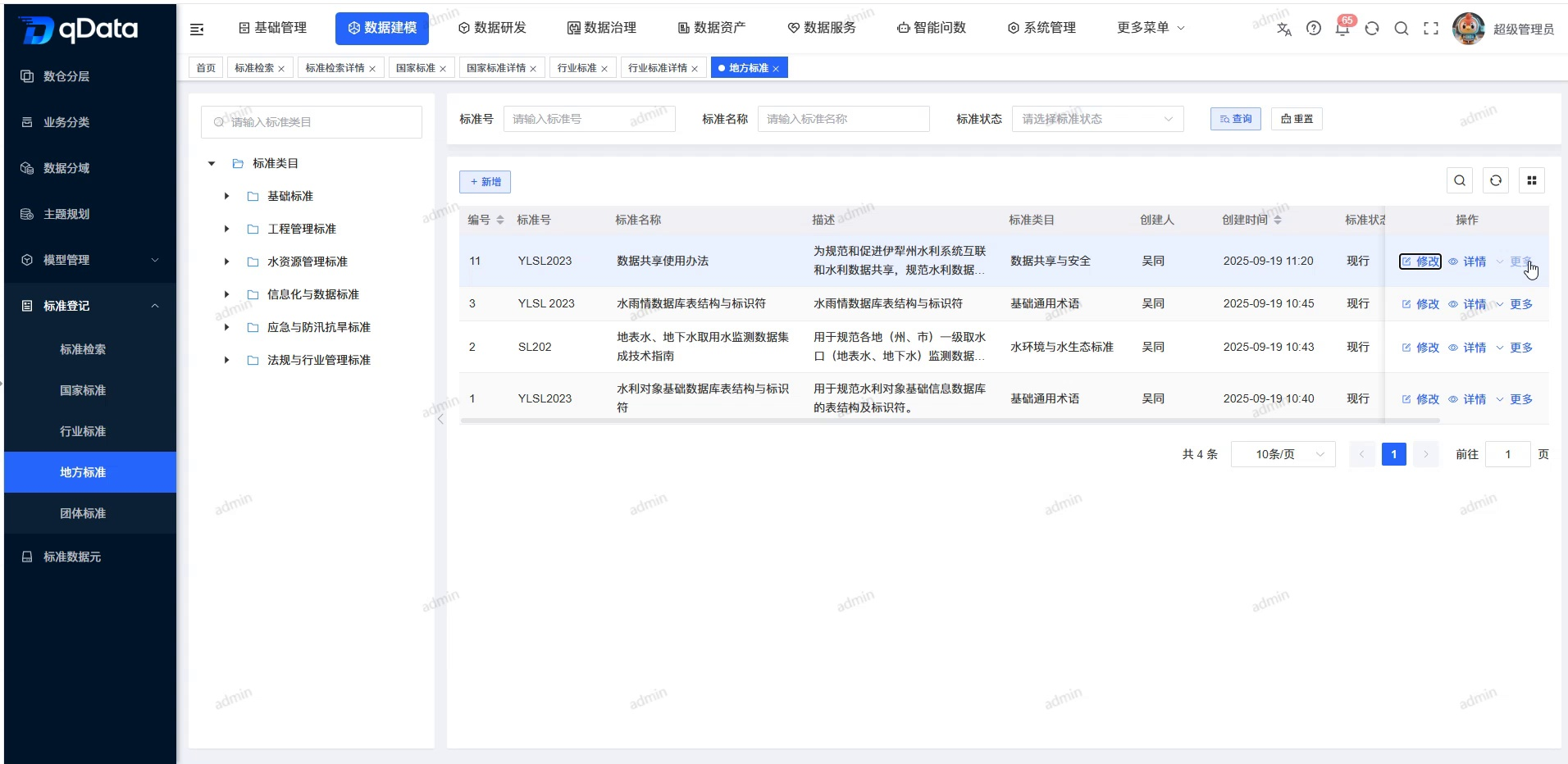
The left side of the page is the standard category search box and standard category tree. The right side provides standard number, standard name, standard status query, as well as [Query] [Reset] [New], local standard list, row operations and paging. You can view the standard name, description, standard category, standard number, standard status and creation information in the list.
Recommended operating procedures
Query scenario: Select the standard category -> Set the standard number, standard name or status -> Click [Query] -> Browse the list -> Use paging to locate the record.
Maintenance scenario: Position [Add] or target row [Modify] -> Check the standard information and files according to the actual form on the page -> Return to the list after submission -> Requery and check the records.
Functional operation instructions
Browse and inquire about local standards
- Enter the standard category name in the category search box on the left.
- Select the target category in the standard category tree.
- Fill in the standard number as needed.
- Fill in the standard name as required.
- Select the standard status as required.
- Click [Query].
- Check the local standard records that meet the requirements.
- When you need to restore the default conditions, click [Reset].
- When you need to view more records, use paging to switch page numbers.
View list information
- Locate the target record in the list.
- View the standard name and description.
- Check the standard category and standard number.
- View the standard status and creation information.
- Select the [Modify], [Details] or [More] entry as needed.
Add or modify local standards
- When you need to add a new record, click [Add] above the list.
- When you need to modify the record, click [Modify] on the target row.
- Check the standard information according to the actual form on the local standards page.
| Field Name | Description | Required or not |
|---|---|---|
| Standard Category | Select the category to which the local standard belongs. | Yes |
| Standard Status | Select the current status of the standard. | Yes |
| Standard number | Fill in the local standard number. | Yes |
| Standard name | Fill in the local standard name. | Yes |
| File | Select the original text or attachment of the local standard. | Yes |
| Issuing organization name | Fill in the standard issuing organization. | No |
| Version number | Fill in the standard version identification. | No |
| Release Date | Select a standard release date. | No |
| Implementation Date | Select the standard implementation date. | No |
| Expiration Date | Select the standard expiration date. | No |
| Description | Fill in the standard summary. | No |
| Remarks | Fill in the supplementary instructions. | No |
- Submit or cancel the operation according to the actual prompts on the page.
- After returning to the list, query the target record again and check the results.
View details of local standards
- Click [Details] in the target record row.
- Check the local standard record corresponding to the opened page.
- View the standard number, standard name, standard category, status and file information.
- Use the page's actual return entry to return to the list.
Use the [More] entrance
- Click [More] in the target record row.
- Check the actual extended operations provided on the local standards page.
- Continue execution after confirming the operation object and impact.
FAQ
- What should be checked when adding or modifying?
focuses on checking the standard category, standard status, standard number, standard name and file, and confirms that the issuing agency, version and date information are consistent with the original text of the standard.
Summarize
The local standards page is used to classify and query and maintain local standards information. When using it, you should focus on checking the standard number, standard name, standard status and original document , and refer to the actual form, details and operation tips on the local standards page.