
Pro Edition Product Introduction
qData Data Platform Pro Edition is the core enterprise-grade data infrastructure product built by Qiantong Tech for digital transformation in government and enterprise scenarios. It is not a single software tool, but the flagship product in an enterprise-grade Data Platform Suite that covers the full process of data construction, governance, assetization, and services.
In the deep-water zone of digital transformation, enterprises often face pain points such as scattered data silos, conflicting statistical definitions, and data assets that are hard to reuse. Positioned as a "chief data steward", qData Pro Edition unifies raw data scattered across ERP, CRM, MES, and other business systems, then cleans, models, and standardizes it into high-quality, reusable digital assets, and efficiently empowers business innovation through API services.
Core Value: Break data barriers, unify the data language, upgrade data from "technical resources" to "business assets", and move from "viewing data" to "using data".
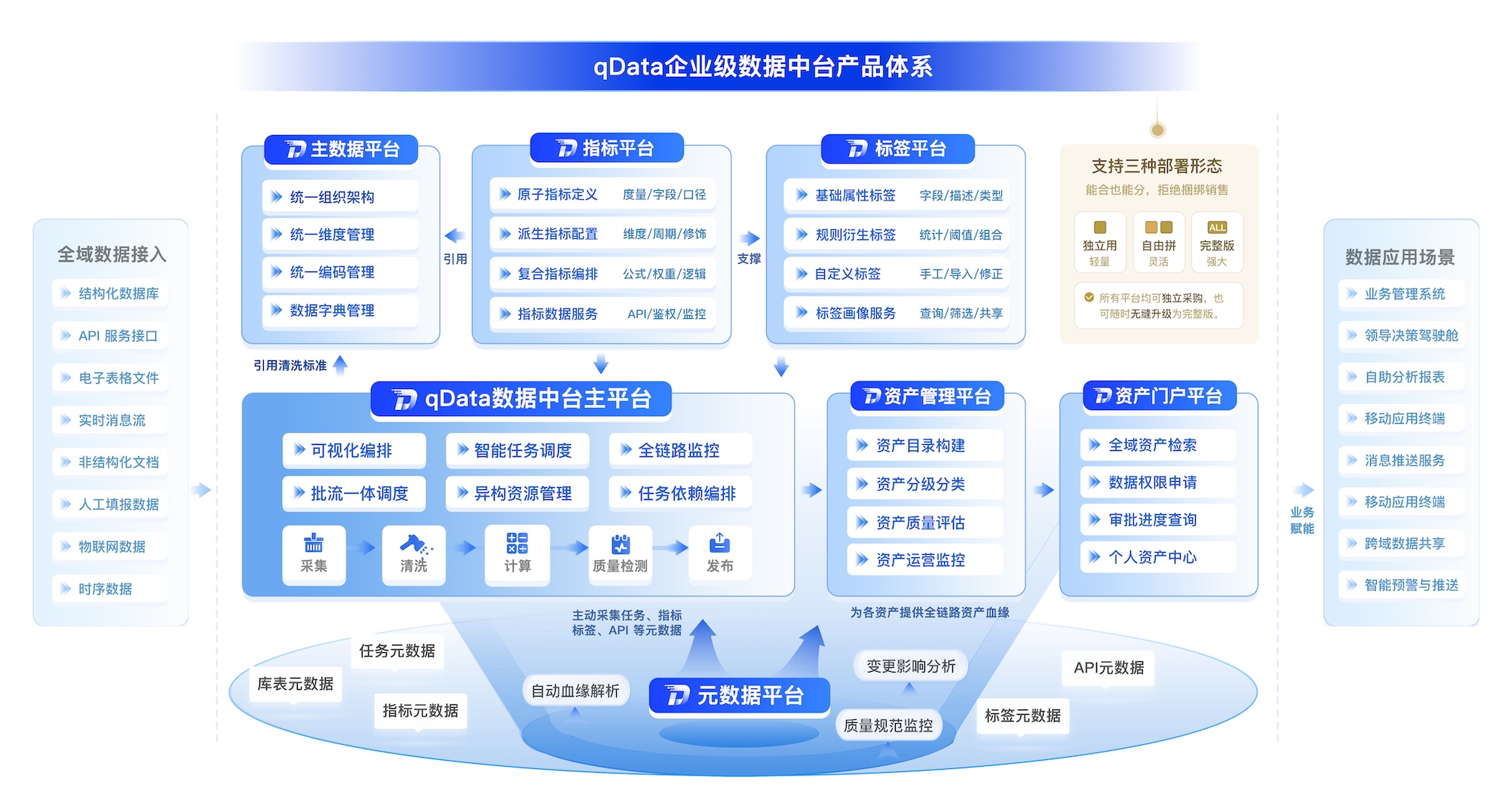
Product Positioning: A Flexible "1 + 6" System
qData adopts an innovative "1 + 6" product matrix architecture, ensuring complete foundational capabilities while providing deep extensibility for complex scenarios.
🏆 1 Core Main Platform: qData Data Platform Pro Edition
This is the "main product" most customers purchase. It is an independently running, fully functional complete system with lightweight built-in metadata management, master data merging, basic asset catalog, and quality checking modules.
- Applicable scenarios: Most small and medium-sized enterprises, department-level Data Governance projects, or regular business scenarios.
- Advantages: Out of the box. Without additional purchases, it can solve more than 80% of Data Integration, development, and asset management needs, with excellent cost performance.
🚀 6 Professional Sub-Platforms: Deep Engines Selected on Demand
For super-large groups, highly complex governance, or deeply refined operations scenarios, we provide six independent professional sub-platforms. They integrate seamlessly with the main platform and support on-demand purchase and flexible stacking:
- Metadata Platform: Full-link lineage analysis and global navigation (Professional Premium Edition).
- Master Data Platform: Authoritative unification of core cross-system objects such as people, finance, and things (Professional Premium Edition).
- Metrics Platform: Unified definition and calculation of enterprise-level metric standards (Professional Premium Edition).
- Tag Platform: Fine-grained user profile construction for business scenarios (Professional Premium Edition).
- Data Assets Platform: Deep asset operations and full-lifecycle governance (Professional Premium Edition).
- Data Assets Portal: One-stop self-service data hall for all employees (Professional Premium Edition).
💡 Selection recommendation: We follow the principle of matching investment to need. If you only need basic data connectivity and management, purchasing only the Pro Edition main platform is already enough. If you have advanced needs, you can flexibly add the corresponding sub-platforms to ensure every investment is worthwhile.
Core Features
qData Data Platform Pro Edition focuses on the full-link data production capability, providing a closed-loop experience from access to services and covering eight core capability domains:
1. Full-Domain Data Integration (Visual ETL & Bulk Sync)
- Zero-code visual development: Based on the DAG engine, complex ETL processes can be built by dragging components for input, transformation, and output. Spark/Flink dual-engine scheduling is supported.
- Full-source heterogeneous access:
- Relational databases: MySQL, Oracle, SQL Server, PostgreSQL, DM8, Kingbase8, DB2, OSCAR, and more.
- Big data engines: Hive, Doris, ClickHouse, Phoenix.
- NoSQL & message queues: MongoDB, Redis, Kafka, RabbitMQ.
- File storage: FTP, OSS (Alibaba Cloud), HDFS, Excel, CSV.
- Full database synchronization wizard: Supports one-click selection of multiple source tables, automatically maps target table structures, configures partition/bucket rules, and applies to batch warehousing and migration scenarios.
- 🤝 Customization commitment: For special data sources not listed, the official team promises free customization development within 5 person-days after contract signing.
2. Professional Data Development (Web IDE & Orchestration)
- Online code development: Provides a Web IDE, supports SQL, Flink SQL, Python, Java, and other languages, and is compatible with connection types such as DM8, Oracle, Hive, SparkSql, and Flink.
- Job orchestration and scheduling: Supports orchestrating integration tasks and development tasks into jobs by dependency relationships, with serial/parallel execution, branch convergence, failure retry, delayed execution, and other advanced scheduling strategies.
- Intelligent operations monitoring: Unified viewing of run status, log details, and duration analysis for full database synchronization, integration, development, and job instances, with multi-dimensional filtering and categorized retrieval.
- Project space isolation: Supports parallel management of multiple projects, fully isolating categories, members, permissions, and resources to ensure multi-team collaboration without interference.
3. Standardized Data Services (API Factory)
- Rapid API generation: Supports single-table wizard mode and SQL script mode to quickly encapsulate data tables as standard RESTful APIs.
- Full lifecycle management: Covers API design, parameter configuration, version control, publishing, rate limiting, circuit breaking, and offline management.
- Security and operations: Based on the OAuth2 protocol (AppKey/AppSecret), provides application authorization management, request log auditing, exception monitoring, and online debugging tools.
4. Built-in Data Governance System (Built-in Governance)
Pro Edition includes powerful governance modules far beyond the basic capabilities of Open-Source Edition:
- Metadata management: Automatically collects full-link metadata (tables, fields, views), and supports version comparison, change tracking, and table-level lineage analysis.
- Master data management (MDM): Supports master data entity modeling, coding rule generation (serial/date/custom), data maintenance, subscription distribution, and push record traceability to ensure consistency of core objects.
- Data Quality management: Built-in 20+ Audit Rules (completeness, uniqueness, validity, etc.) and 30+ Cleansing Rules (deduplication, formatting, empty value filling, etc.), supporting quality task scheduling, scoring reports, and closed-loop problem data handling.
- Data Security grading: Supports sensitive data identification, classification and grading (L1-L4), masking rule configuration (masking/replacement/clearing), and whitelist management.
5. Data Assets Management (Asset Management)
- Asset Map: Centrally displays multiple asset types such as database tables, APIs, and files, and supports multi-dimensional retrieval by topic, category, and tag.
- Asset panoramic view: Provides one-stop viewing of asset details, field structures, lineage relationships, quality scores, and related rules.
- Terminology and tag system: Supports standardized business terminology management to eliminate ambiguity, and supports custom tag systems to help assets be quickly classified and found.
- Ad hoc Data Query: Provides an SQL editor, supports temporary cross-source data queries, result preview, and export.
6. Data Visualization (BI & Dashboard)
- Report design: Supports multi-dimensional data analysis, provides rich charts such as bar charts, line charts, and pie charts, and supports custom reports and data drill-down.
- Large-screen dashboard design: Drag-and-drop visual editor with built-in maps, dashboards, and other components, supporting real-time data access and large-screen publishing.
- Dashboard monitoring: Flexibly combines multi-dimensional indicators to build business monitoring panels and grasp core indicators in real time.
7. Data Warehouse Planning and Modeling (Data Modeling)
- Standards and layering: Supports national, industry, local, and group standard management; supports data warehouse layer configuration and naming standard definition for source-aligned layer, common layer, application layer, and more.
- Business architecture: Supports tree-based management of business categories, data domains, and topic domains to build clear data business boundaries.
- Model design: Supports Logical Model design (dimension/detail/summary/application tables) and materialized model publishing, automatically generating physical table structures.
8. System-Level Basic Capabilities
- Fine-grained permission control: Based on the RBAC model, supports menu-level, button-level, and data-level permission control, as well as project-level member role assignment.
- Multi-tenant/multi-project management: A complete project space isolation mechanism ensures exclusive resource usage.
- Comprehensive log auditing: Records user operations and system run logs to meet compliance audit needs.
Why Choose qData Pro Edition?
🛡️ Source Code Delivery, True Independent Control
Through source code authorization, the data platform is transformed from "black-box software" into the enterprise's technical asset. Source-level delivery + complete authorization = data infrastructure that truly belongs to the enterprise, enabling independent control and long-term technical accumulation.
🏗️ Flexible Architecture, One-Click Switch Between Monolith and Microservices
The default architecture is monolithic, making it easy to get started and validate quickly. It is also tailored for a microservice architecture, which can be switched through simple configuration. It meets agile needs while providing unlimited scalability, fitting the full path from small and medium scenarios to enterprise-level implementation.
🧩 Complete Product System, Seven Platforms Freely Combined
qData is not a single system, but a product system covering the full process of data construction, governance, assetization, and services. It includes seven platforms: Data Platform (main platform), Metadata Platform, Tag Platform, Metrics Platform, Master Data Platform, Data Assets Management Platform, and Data Assets Portal Platform. It can be used independently and lightly, or flexibly combined. The complete suite better supports large and complex projects.
📚 Beyond Tools, Providing Full-Lifecycle Business Support
We provide not only technical docs, but also a supporting business documentation system covering the full process of pre-sales, project initiation, bidding, construction, implementation, reporting, and promotion. This helps customers efficiently complete internal project approval, external bidding, and result reporting, greatly reducing project advancement resistance.
💡 Deep Enablement to Ensure "Can Use, Easy to Use, Use Well"
We do not just sell products. We also provide complete training on basic concepts, system usage, development guidance, and design philosophy, ensuring customer teams can not only deploy the system but also deeply understand the essence of a data platform and truly realize product value.
💻 Fully Self-Developed Core, No Open-Source Patchwork
All core functions are self-developed, not simple assembly of third-party open-source projects. Product quality, security, and stability are better guaranteed, avoiding potential risks brought by open-source components.
🚀 Technically Forward-Looking, Rebuilt and Evolved from Practice
The current Pro Edition was rebuilt and evolved on the basis of an internally accumulated 1.0 version. It adopts the latest, most mainstream, and most scientific technical architecture, with better scalability and long-term maintenance value.
🔗 Same-Origin AI Ecosystem, Seamless Connection
qData is a core component of the Qiantong Intelligent Platform Suite and shares the same origin with platforms such as qThing, qKnow, qModel, qLabel, and qBrain. Combined use can seamlessly build industry-level deep AI solutions and reserve ample room for intelligent transformation.
⚙️ Modular Design, Lower Operations Costs
The system fully adopts modular design, with internal modules that are highly cohesive and loosely coupled. This greatly reduces subsequent iteration development difficulty and system operations costs, making the system lighter and easier to maintain.
🌐 Mainstream Technology Stack, High Environmental Fit
The system fully adopts the latest mainstream technology stack, making it more compatible with the existing technical environments of customers and partners, and reducing integration difficulty and learning costs.
🔄 Dual-Version Strategy for Diverse Needs
Both Open-Source Edition and Pro Edition are provided to meet diverse needs across different budgets and customer stages, allowing you to flexibly choose the most suitable starting point.
Applicable Scenarios
- Data silo governance: Connect heterogeneous systems such as ERP, CRM, and MES, unify data definitions, and eliminate statistical differences.
- Data asset accumulation: Transform scattered technical data into manageable, reusable business assets and build an enterprise-level data catalog.
- Agile Data Services: Quickly respond to data needs from business departments, efficiently provide data support through APIs, and reduce duplicate development.
- Industry digital foundation: Widely applicable to water conservancy, smart parks, intelligent manufacturing, energy and power, healthcare and education, transportation and logistics, and other industries, empowering business innovation as a general-purpose "data operating system".
Version Comparison and Upgrade
| Feature | qData Open-Source Edition | qData Pro Edition |
|---|---|---|
| Positioning | Lightweight starter, suitable for learning and small-scale pilots | Enterprise-grade all-round expert, suitable for production environments and complex scenarios |
| Data source support | Basic relational databases (MySQL/Oracle/DM8) | Full-source support (including big data/NoSQL/message queues/files) |
| Core functions | Basic integration, development, API | Full database synchronization, job orchestration, master data, quality/security governance, visual large-screen dashboard |
| Governance rules | A small number of built-in rules (secondary development required) | Built-in 20+ Audit Rules, 30+ Cleansing Rules |
| Technical support | Community support | Dedicated vendor technical support, SLA guarantee, customized implementation service |
| Business docs | Basic technical docs | Full business support docs (project initiation/bidding/reporting, etc.) |
| Authorization model | Apache 2.0 (Logo retained) | Permanent commercial authorization (including source code, brand customization, invoice and contract) |
| Upgrade path | - | Supports seamless and smooth upgrade, same origin without fragmentation |
💡 Upgrade tip: Whether you start from Open-Source Edition or directly choose Pro Edition, qData provides an unobstructed upgrade path. As your business grows, you can easily switch to the more powerful Pro Edition at any time to ensure continuous technical competitiveness.
🚀 Start Your Enterprise Data Journey Now
qData Data Platform Pro Edition is not only a powerful data processing platform, but also a solid foundation for enterprises to build data-driven capabilities. With a flexible model of "built-in fundamentals + advanced options", it balances cost effectiveness and deep expansion capability. Combined with source code delivery and full-lifecycle service, it is an ideal choice for government and enterprise customers moving toward data assetization and digital transformation.
📡 Get a Quote and Demo Account
We know that every enterprise's data scenario is unique. To help you experience the powerful capabilities of Pro Edition more intuitively and obtain a tailored authorization plan:
- 💻 Apply for a Pro Edition demo account: Scan the QR code to add us on WeChat. We will open a dedicated high-permission demo environment for you and walk you through the full process from data access to asset services.
- 💰 Get an official quotation plan: Based on your project scale, data volume level, and functional needs (such as whether the six sub-platforms are required), we provide a transparent and flexible quotation list.

Act now and make data truly become a core enterprise asset!