
Product Introduction







🌈 Platform Introduction
qData Data Platform is an enterprise-grade data management platform integrating data integration, standard management, asset governance, quality control, service opening, and intelligent analytics. It is committed to helping enterprises achieve unified management, efficient governance, and value release of data resources. We follow the philosophy of "efficient, secure, flexible, and open", continuously introduce advanced technologies, and help data become a core driver of enterprise development.
qData Data Platform provides two forms: Community Open-Source Edition and Pro Edition, meeting user needs at different scales and in different scenarios.
- Community Open-Source Edition: focuses on core functions, including basic management, common data source access, modeling and quality validation. It is lightweight and easy to use, with a low entry threshold, suitable for SMEs or individual developers to quickly practice and explore.
- Pro Edition: provides complete functionality, covering the full chain of system management, data access, modeling, security, and services. It is carefully polished, suitable for large-scale and complex scenarios, and provides dedicated services and intelligent capabilities to help enterprises run stably and efficiently.
The two editions each have their own characteristics and complement each other. The Community Open-Source Edition is more like an introductory teacher, helping you get started at low cost; the Pro Edition is more like an expert consultant, providing depth and assurance. Whichever edition you choose, qData Data Platform can become a reliable partner, helping enterprises release data value and accelerate digital transformation.
✨✨✨Community Open-Source Edition Demo Address✨✨✨ https://qdata-demo.qiantong.tech, account: qData password: qData123
✨✨✨Pro Edition Demo Address✨✨✨ https://qdata-pro.qiantong.tech, for a demo account please contact customer service
Give Us Some Encouragement 🚀
If qData helps you, please give us a Star ⭐️. This will be our greatest motivation to keep updating!
👉 [Star the project on Gitee] | 👉 [Star the project on GitHub]

✅ Feature List
The platform uses a modular design and covers 12 core functional modules. For the detailed feature list, see: qData Feature List Overview
| No. | Module | Function description |
|---|---|---|
| 1 | System Management | Provides platform-level basic O&M and permission control capabilities, supports full lifecycle management of users, roles, departments, and positions, and implements fine-grained permission control based on the RBAC model. It includes menu configuration, data dictionaries, system parameters, notices, operation log audits, and other functions to ensure system security, stability, and maintainability. |
| 2 | Basic Management | Builds the organizational framework and classification system for data management, supports topic categories and multi-dimensional category management such as data assets, logical models, APIs, and tasks, and uses tree structures to standardize asset classification and enable quick retrieval, providing basic support for orderly organization of data resources. |
| 3 | Data Collection | Supports unified access and management of multiple data source types, covering mainstream relational databases such as MySQL, Oracle, and Dameng, big data platforms such as Hive, Doris, and ClickHouse, message queues such as Kafka, and file systems such as OSS and HDFS. It provides connection testing to ensure data source connectivity and stable input for subsequent data processing. |
| 4 | Data Standards | Focuses on data standardization construction and provides logical modeling, data element management, dictionary table definition, and model materialization capabilities. It supports reverse importing structures from physical databases to generate logical models and associate them with standard data elements, promoting integrated "design-standard-implementation" and ensuring unified data definitions and consistent calibers. |
| 5 | Data Assets | Implements comprehensive inventory and visual presentation of enterprise data assets, supports asset map management, multi-source data discovery, metadata change tracking, and scheduling management. The asset details page displays multidimensional information such as structure, lineage, and quality, improving data discoverability and trustworthiness and supporting data asset operations. |
| 6 | Data Governance | Provides complete data integration and development capabilities, supports ETL task configuration, real-time stream processing (Flink), job orchestration, and O&M monitoring. Built-in transformation components and cleansing rules support traceable data processing and distribution, building an efficient and stable data processing pipeline for complex Data Governance needs. |
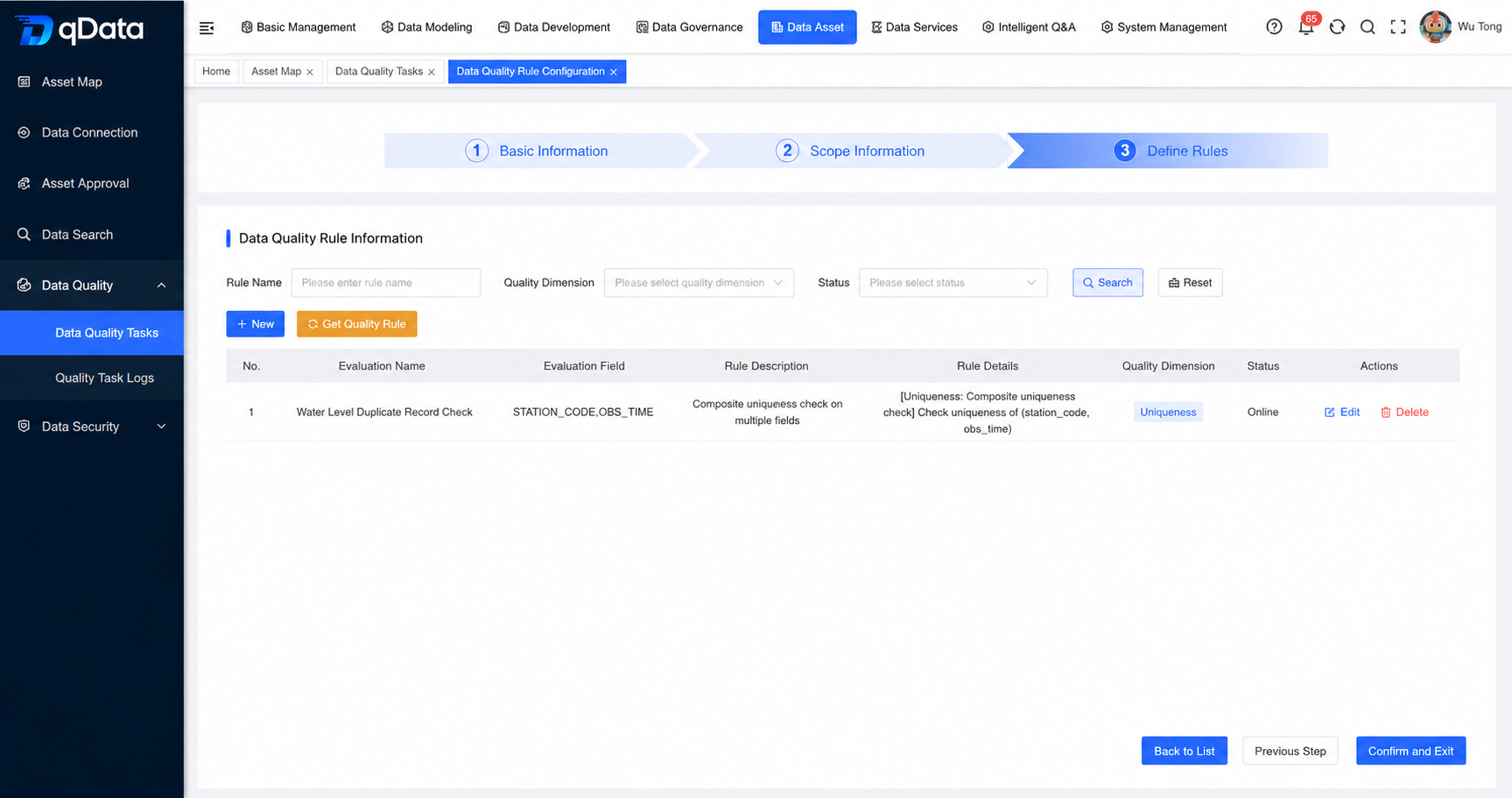
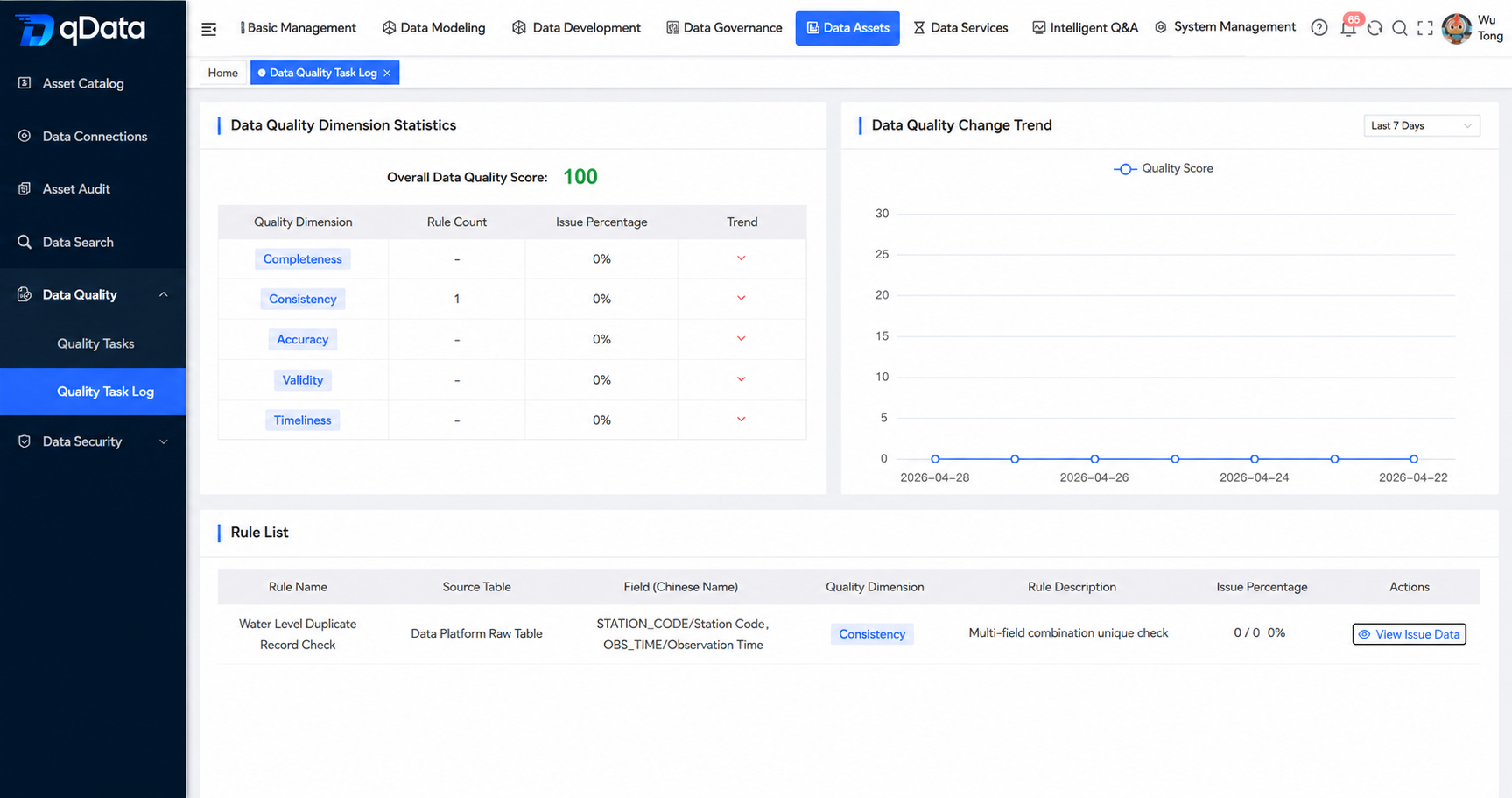
| 7 | Data Quality | Provides configurable Data Quality audit and cleansing rules around five dimensions: completeness, uniqueness, validity, consistency, and timeliness. It supports quality task creation, execution scheduling, result analytics, and issue data handling, forming a closed loop of "detection-analytics-repair" to continuously improve data health. |
| 8 | Data Security | Builds a multi-level Data Security protection system, supports data asset classification and grading management, automatically identifies sensitive information and labels levels, and provides technical measures such as access control, data encryption, and dynamic masking to ensure data security and compliance during storage, transmission, and usage. |
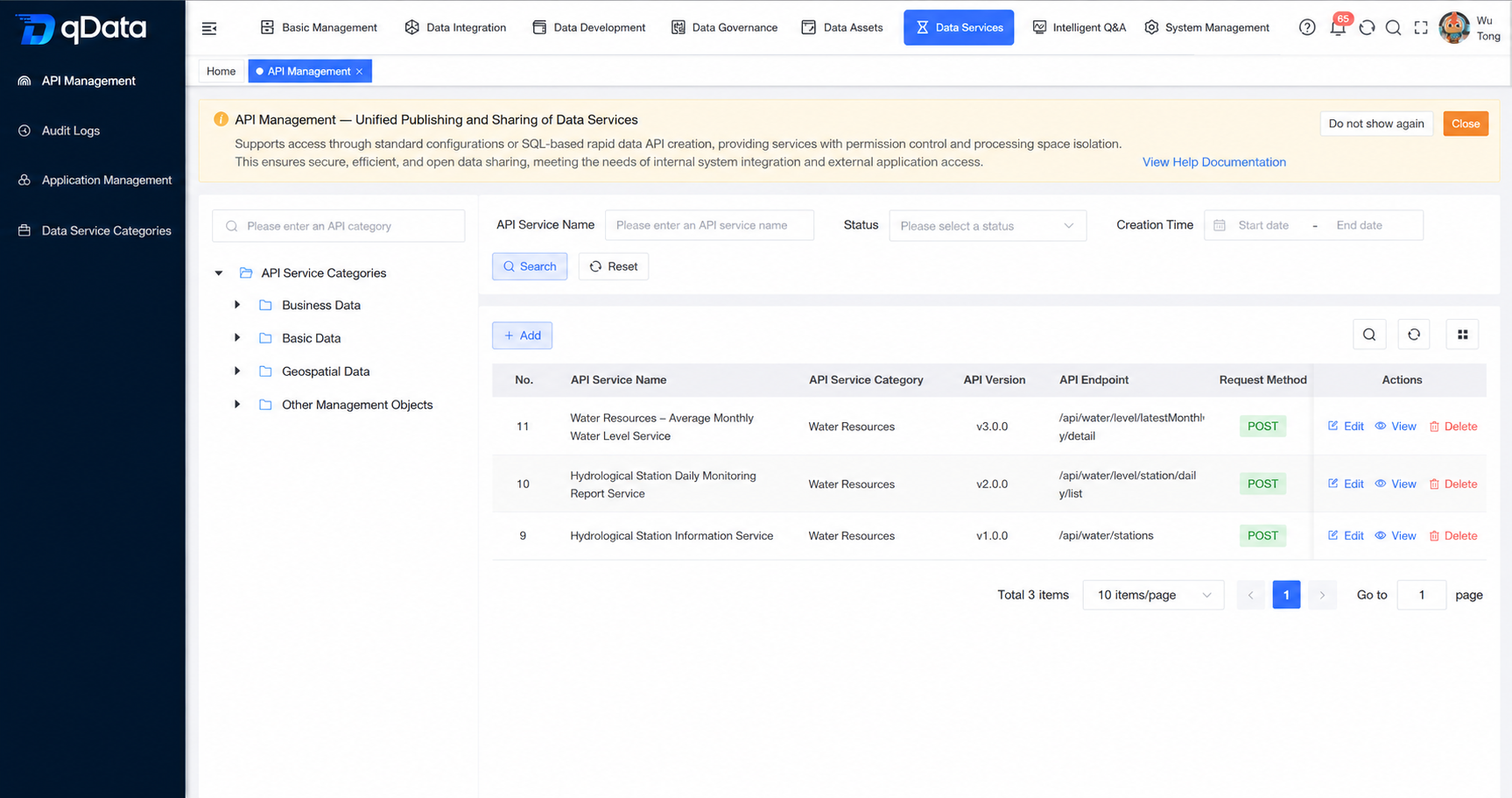
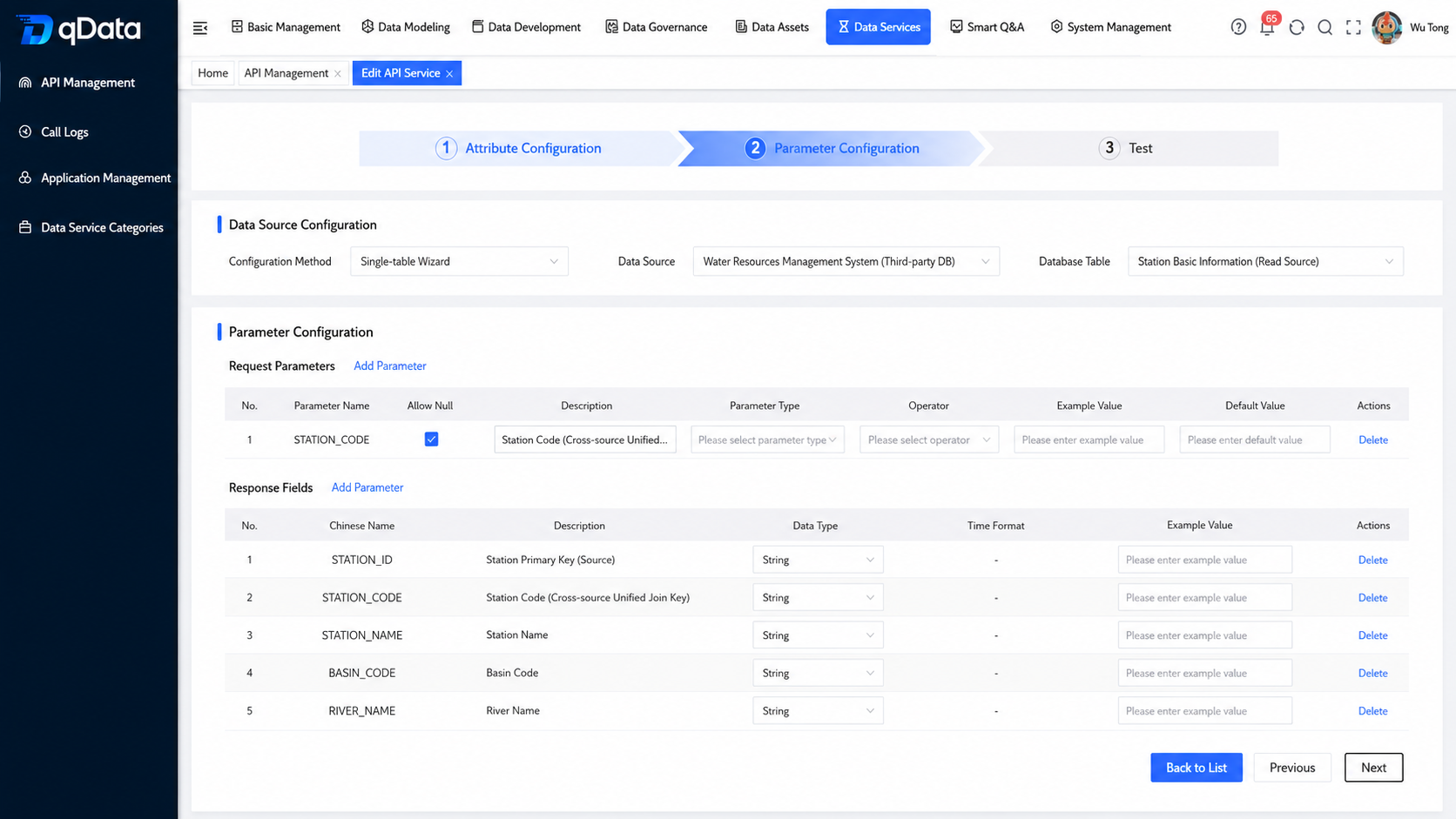
| 9 | Data Services | Encapsulates data capabilities as standardized API services and supports API definition, publishing, authentication, rate limiting, and blacklist management. It provides online testing and request log analytics for service debugging and O&M, promoting data "servitization" and sharing and improving data reuse efficiency. |
| 10 | Data Resource Portal | Serves as the unified user-facing entry point and provides a portal home dashboard, service resource catalog, document center, and personal service application management. It supports data filling, online approval, and backend configuration, creating a Data Services platform that integrates discovery, application, usage, and management. |
| 11 | Data Visualization | Supports visual design of reports, large-screen dashboards, and dashboards, provides a drag-and-drop editor and rich chart components, and supports multidimensional data drilling and real-time refresh. It helps users quickly build business monitoring views and decision dashboards, intuitively presenting data value. |
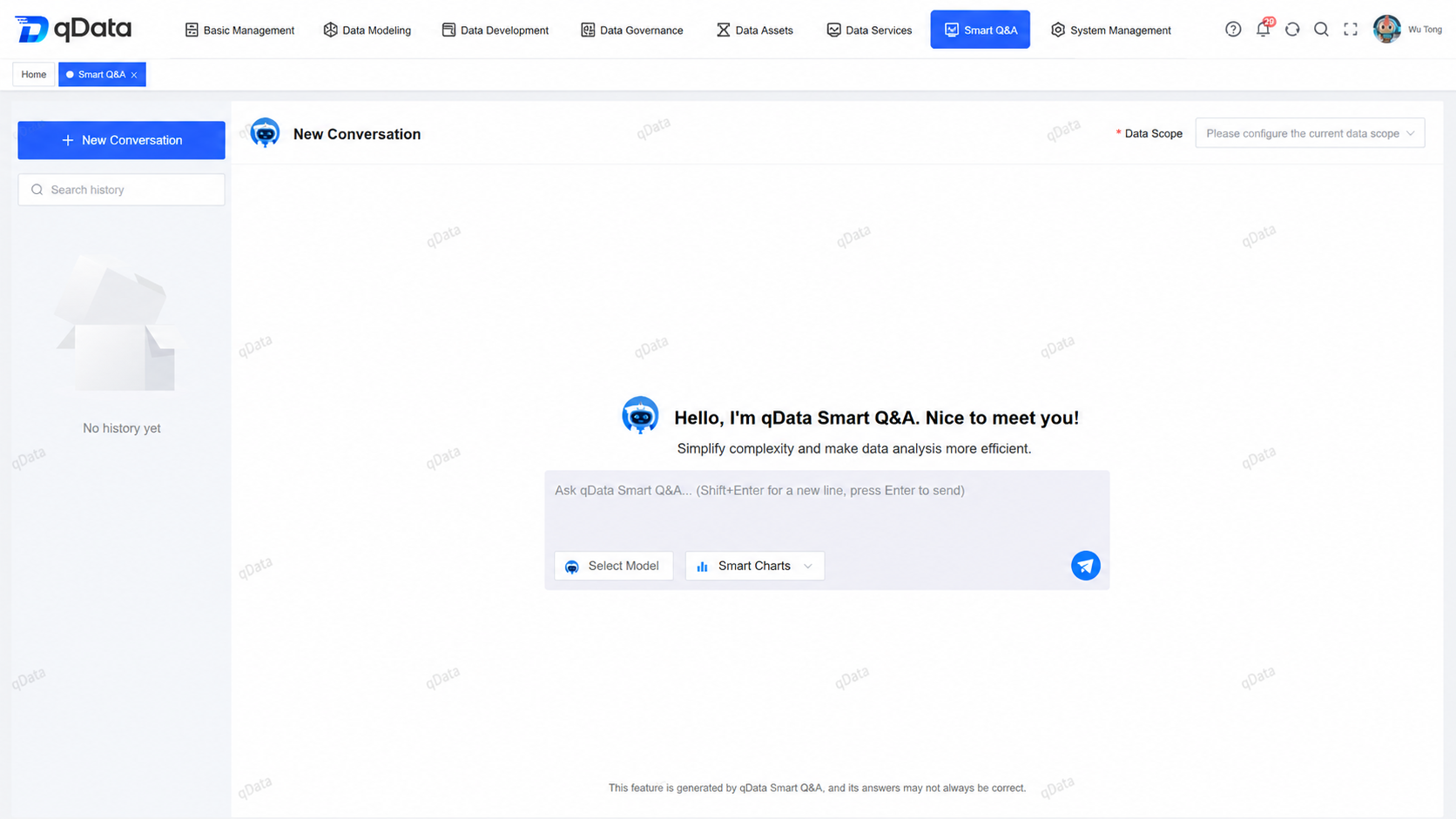
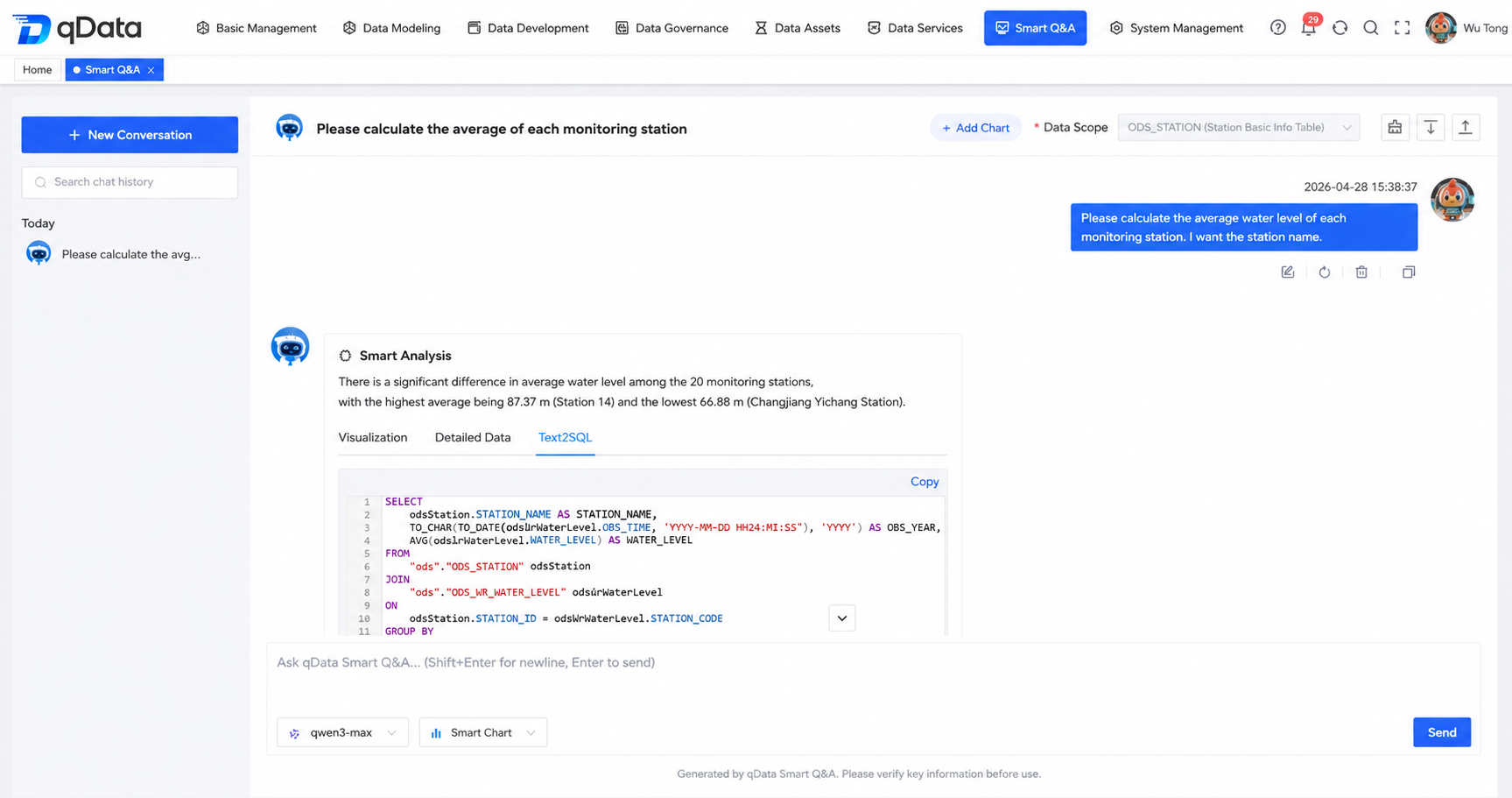
| 12 | Artificial Intelligence | Integrates AI capabilities to improve the data usage experience, provides Text2SQL intelligent query functions, and supports automatically converting natural language into SQL statements for execution. In the future, it will support ChatBI conversational analytics, allowing business users to obtain data insights by asking questions, lowering the data analytics threshold and realizing data inclusion. |
🚧 Future Development Plan
We plan to advance metadata comparison, business-layer modeling, and data-asset refactoring to further improve data governance and asset-management experiences. We will also continue enhancing data integration, data quality, data services, and AI capabilities, expand data sources and ETL components, and optimize quality rules, API services, and Text2SQL analytics.
💡 If you have suggestions or feature requests, please submit an Issue and help us improve the qData Data Platform.
🧩 Overall Architecture
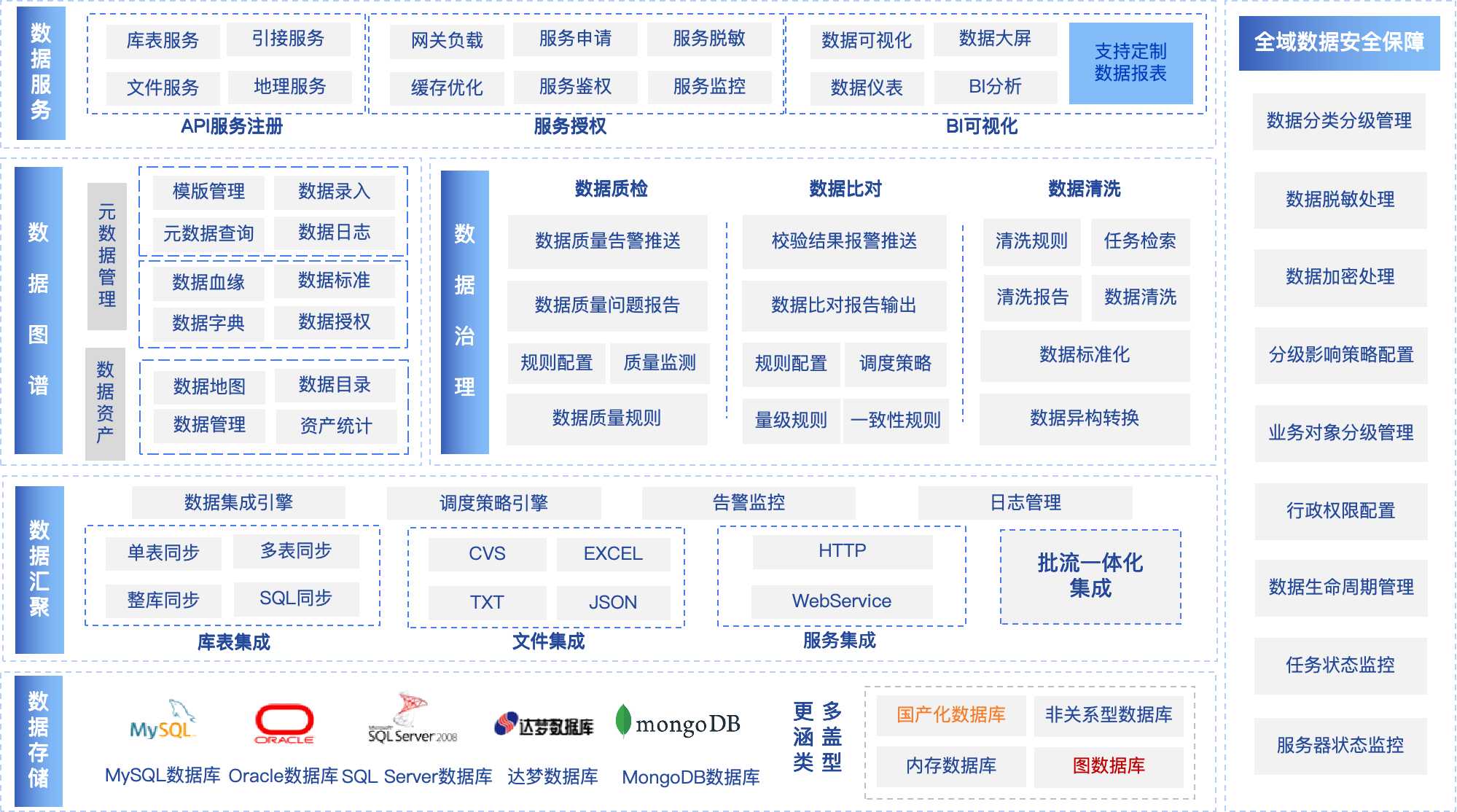
🛠️ Technology Stack
The qData platform uses a frontend-backend separated architecture. The backend is based on Spring Boot, the frontend is based on Vue 3, and the platform integrates some mainstream middleware and data tools.
| Category | Technology | Description |
|---|---|---|
| Backend Technology Stack | Spring Boot | Provides rapid development capabilities, simplifies configuration, and supports microservice and modular application construction. |
| Spring Security | Implements user authentication and permission control, ensuring system data and API security. | |
| MySQL / PostgreSQL / Dameng 8 / Kingbase | Supports multiple mainstream database types and implements reliable data persistence and configuration management. | |
| MyBatis-Plus | Simplifies database operations and provides automated CRUD and flexible extension capabilities. | |
| Redis | Provides high-performance caching, distributed locks, and message queue capabilities, improving concurrent processing efficiency. | |
| RabbitMQ | Implements asynchronous messaging and system decoupling, supporting reliable message delivery and peak shaving. | |
| Frontend Technology Stack | Vue 3 | A modern responsive framework that supports component-based development and efficient frontend rendering. |
| Element UI | Provides rich common UI components to quickly build a consistent interface interaction experience. | |
| Vite | A lightweight development and build tool that supports extremely fast hot updates and efficient packaging. | |
| Third-Party Dependencies | DolphinScheduler | Supports visual task orchestration, dependency management, and distributed scheduling, improving data processing automation. |
| Spark | A batch-stream integrated distributed computing framework supporting ETL, real-time computing, and big data analytics. | |
| Hive | Provides data warehouse capabilities and supports data modeling, partition management, and metadata maintenance. | |
| HBase | Supports efficient storage and queries for large-scale unstructured and semi-structured data. |
🚨 Commercial Licensing
qData is available in Pro Edition and Open-Source Edition to meet the needs of different scales and scenarios. Each has distinct strengths and they complement each other: the Open-Source Edition is like an introductory teacher that helps you start at low cost, while the Pro Edition is like an expert consultant that provides depth and assurance. Whichever edition you choose, qData will be a reliable partner that helps enterprises unlock data value and accelerate digital transformation.
👉 For Open-Source Edition brand licensing or Pro Edition consultation, click to view the details: 💼 Licensing Details
🚀 Quick Start
If you are new to qData, we recommend this order:
- Try online: Log in to the demo environment without installing anything.
- Deploy locally: Start the complete environment with Docker Compose.
- Run from source: Start the frontend and backend from source when you need secondary development.
1. Try Online
- Log in to the Community Open-Source Edition demo to explore the main features without installation.
2. Choose a Deployment Method
- Local deployment: Start the complete environment locally with Docker Compose.
- Run from source: Start the frontend and backend services from source when secondary development is required.
- Self-managed deployment: Manually install, configure, and manage each service; suitable for production, large-scale deployments, and custom configurations.
👉 Complete guide: Open-Source Edition Installation and Deployment
🏗️ Deployment Requirements
Before deploying qData, ensure that the following environments and tools are correctly installed:
| Environment | Item | Recommended Version | Description |
|---|---|---|---|
| Backend | JDK | 1.8 or later | OpenJDK 8 or 11 is recommended |
| Maven | 3.6+ | Project build and dependency management | |
| Dameng 8 | 8.0 | Relational database (can be switched to MySQL) | |
| Redis | 5.0+ | Cache and messaging support | |
| RabbitMQ | Optional | Used for task scheduling and asynchronous communication | |
| Operating System | Windows / Linux / Mac | Runs in all common environments | |
| Frontend | Node.js | 16+ | Build tool dependency |
| npm | 10+ | Package manager | |
| Vite | Latest | Scaffolding tool |
👥 Community Group
Join the QQ community group for qData Data Platform: Join
💡 If you have good suggestions or feature requirements, you are welcome to submit an Issue and improve the data middle-platform together with us.
📹 Daily Live Stream
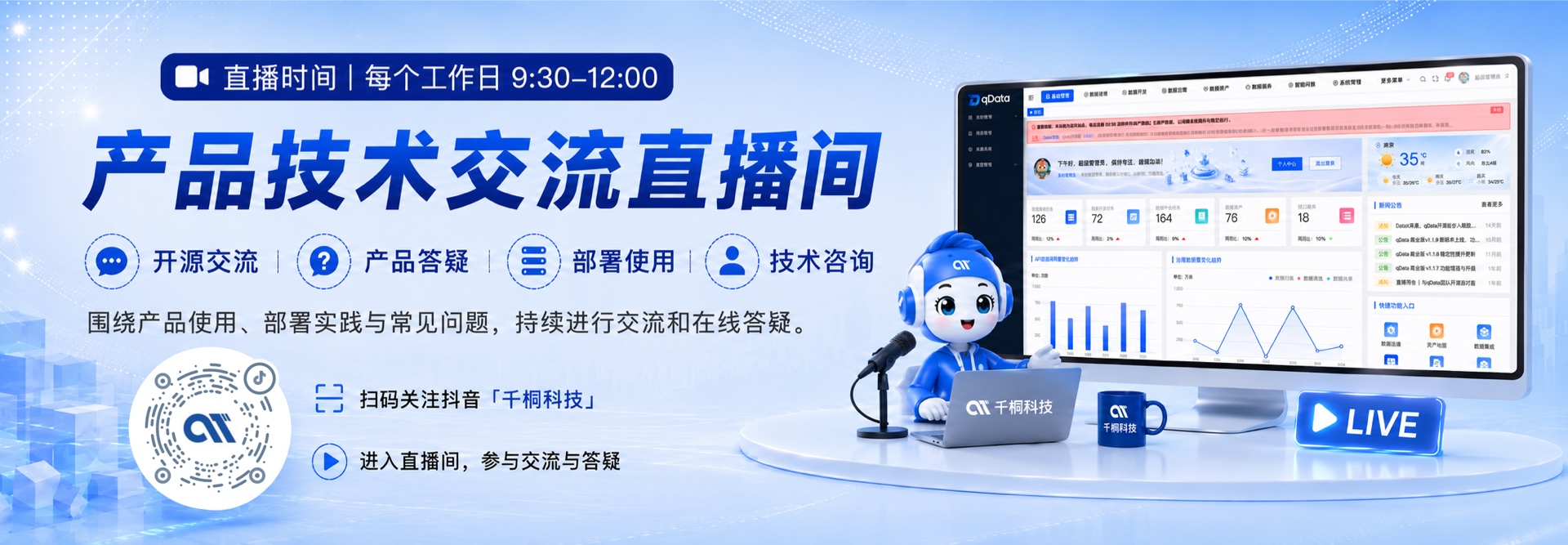
The Qiantong Technology product and technical exchange live stream starts every business day from 09:30 to 12:00. It covers open-source discussions, product Q&A, deployment and usage, and technical consulting, with answers to practical qData questions and experience from real-world implementations.
How to watch
Scan the QR code to follow the official Qiantong Technology Douyin account. Join the live stream from 09:30 to 12:00 on any business day for product Q&A and technical discussions.
🖼️ System Screenshots
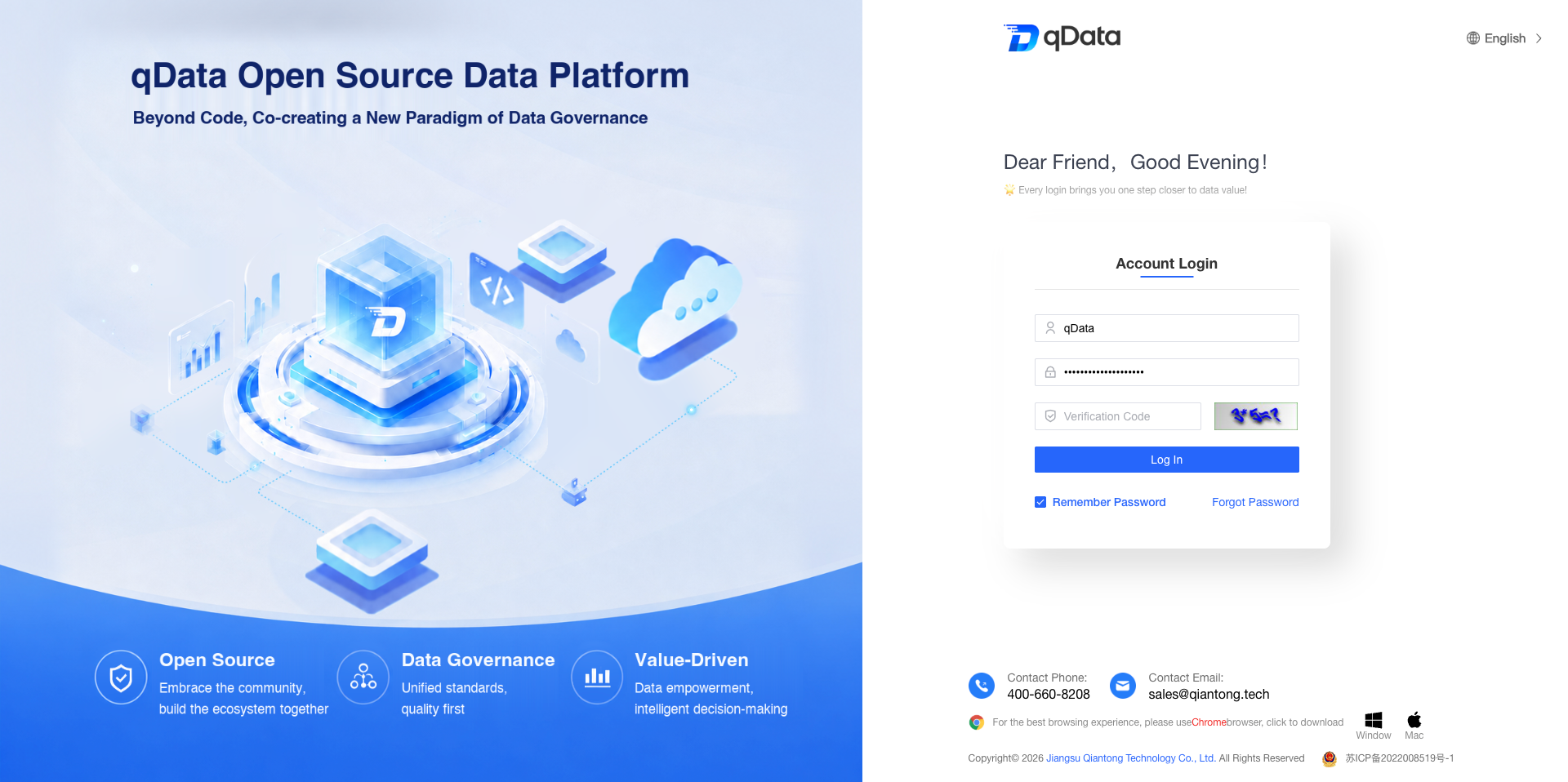 | 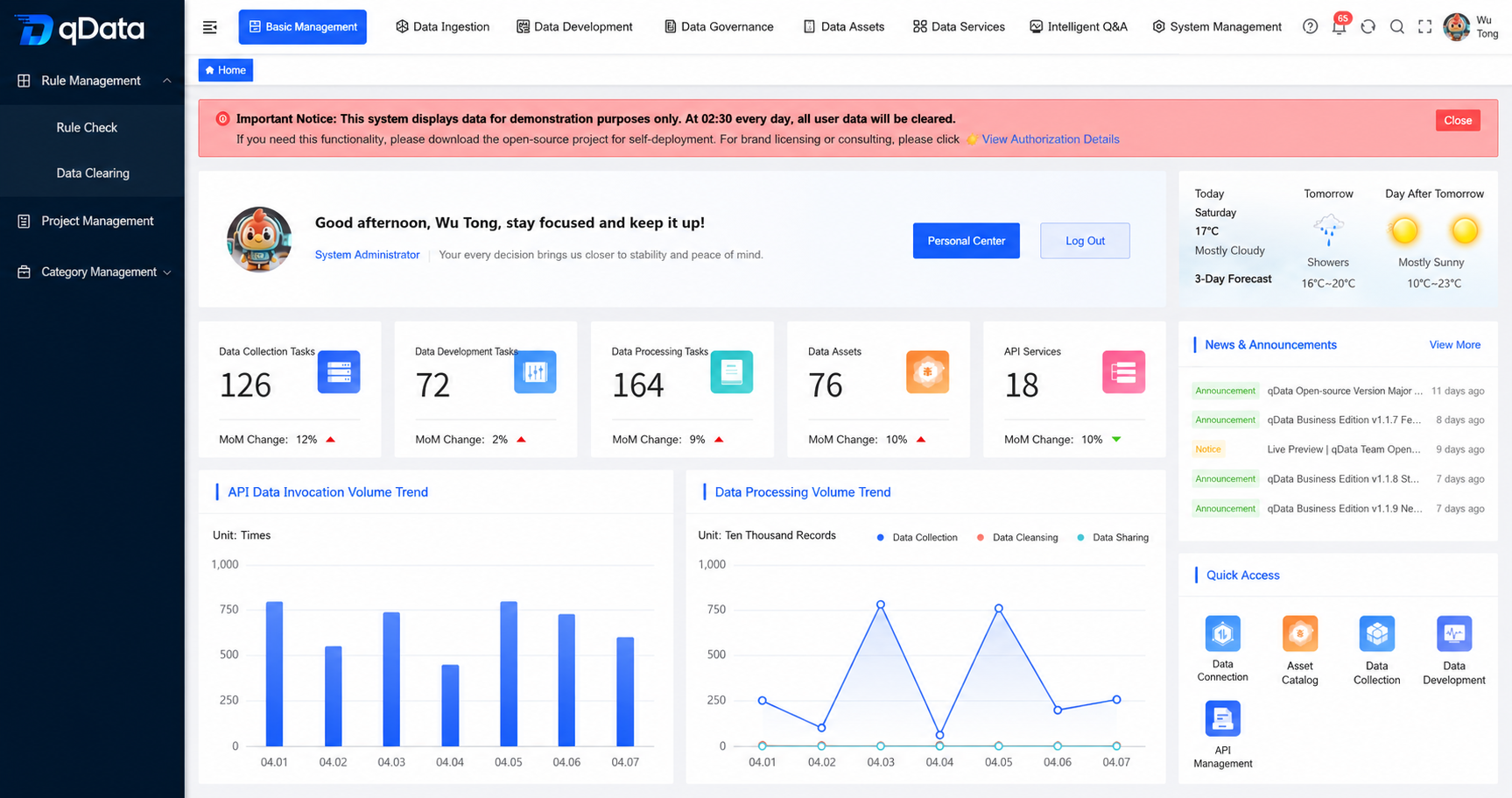 |
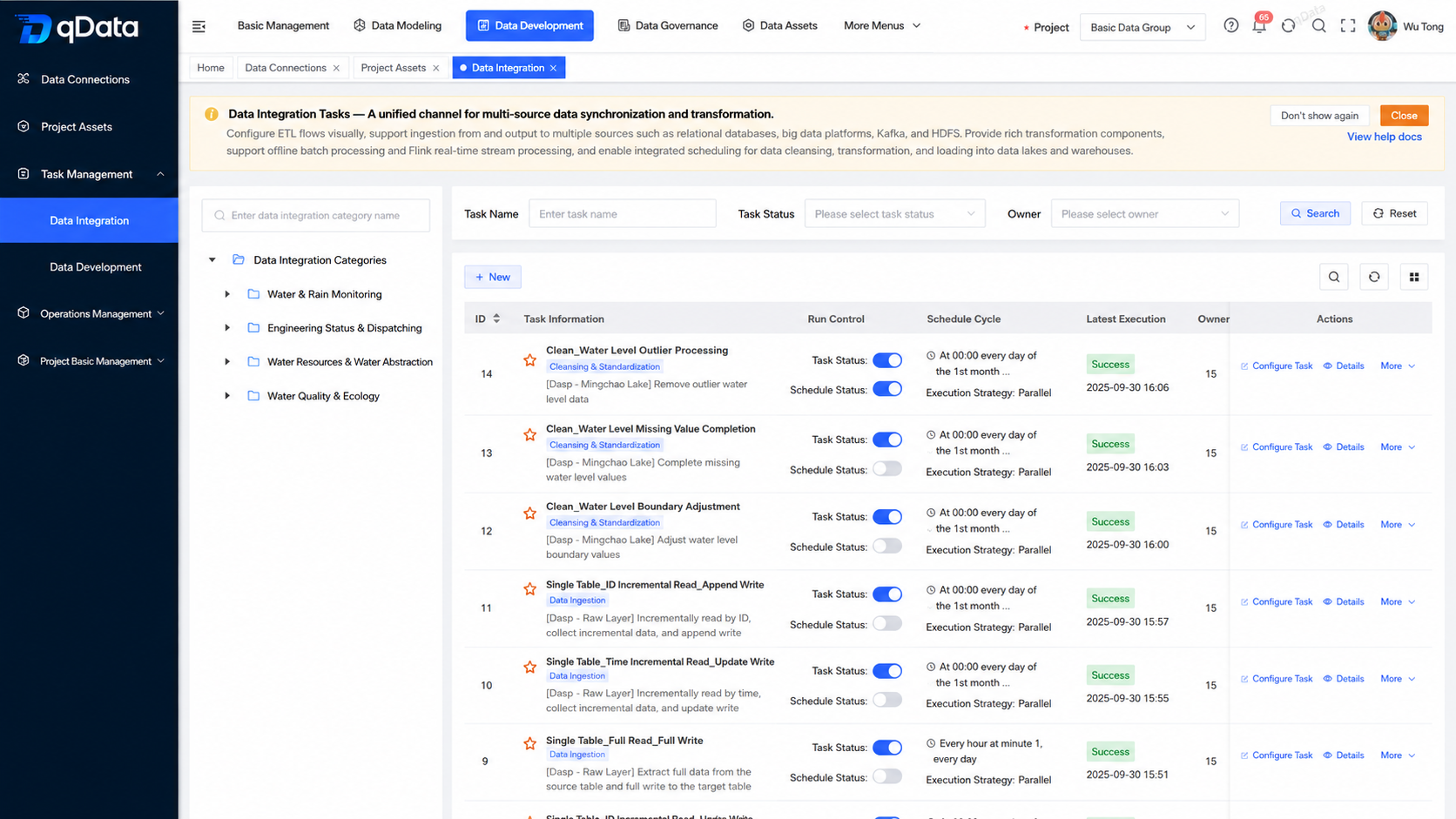 | 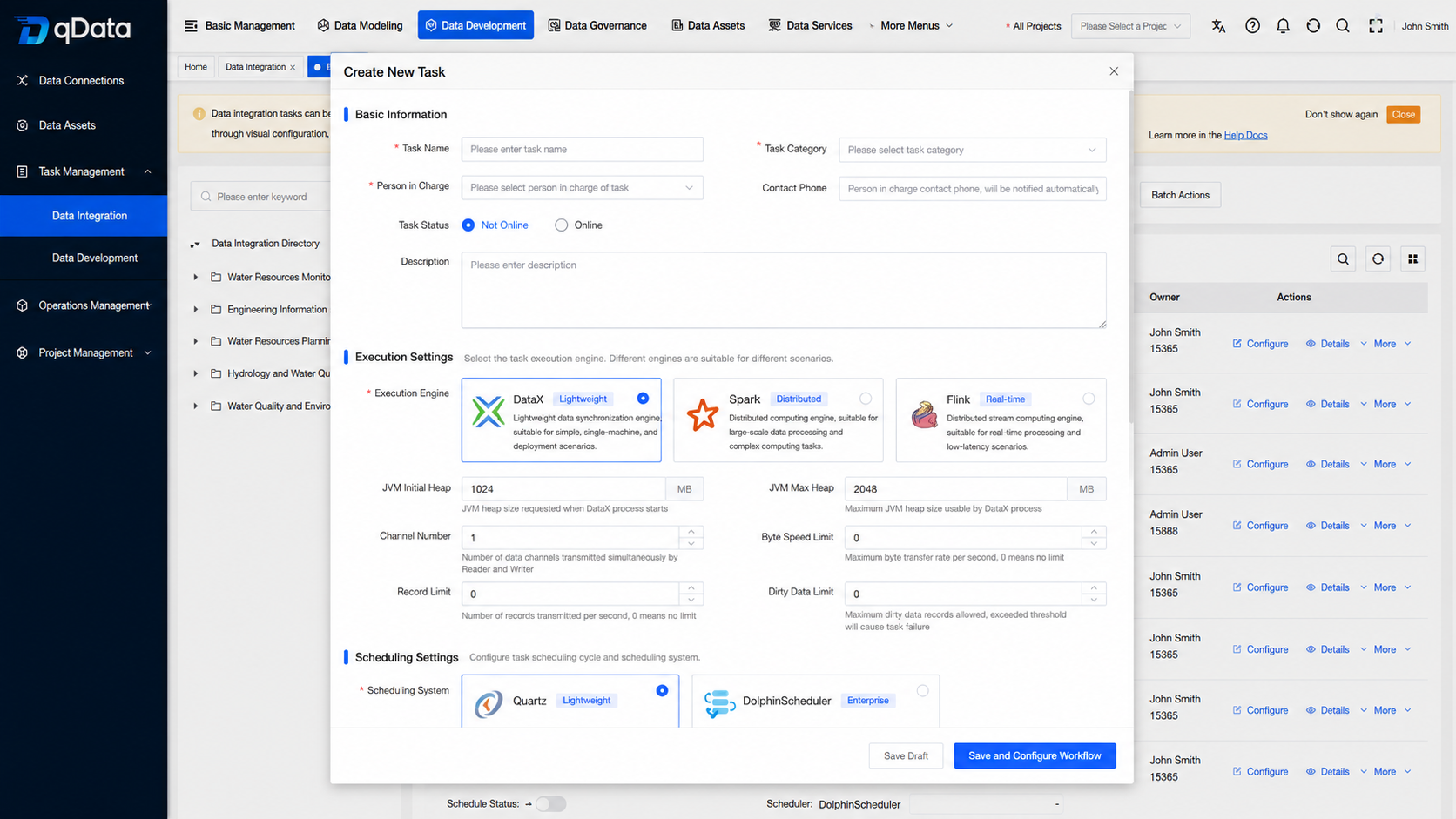 |
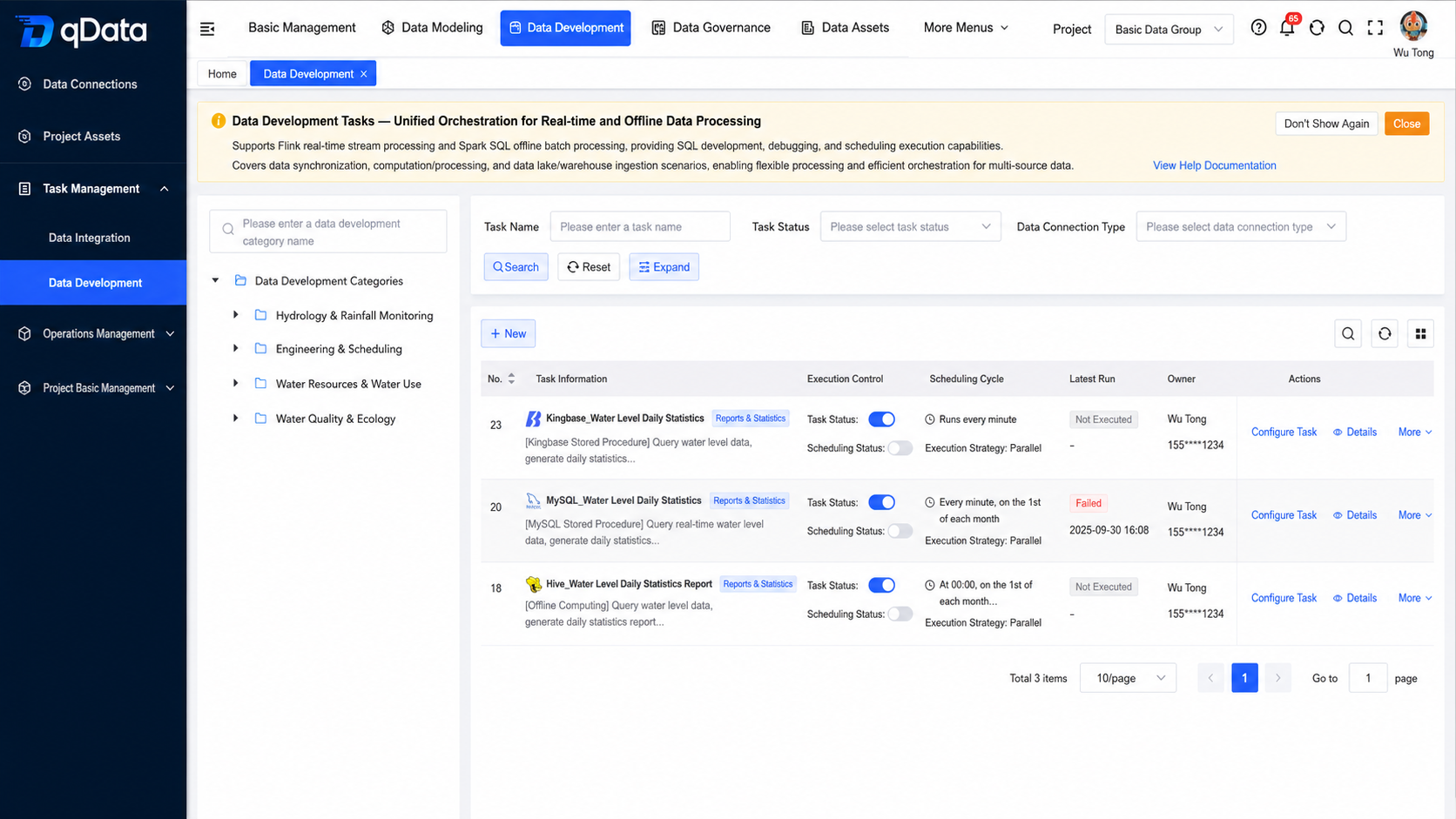 | 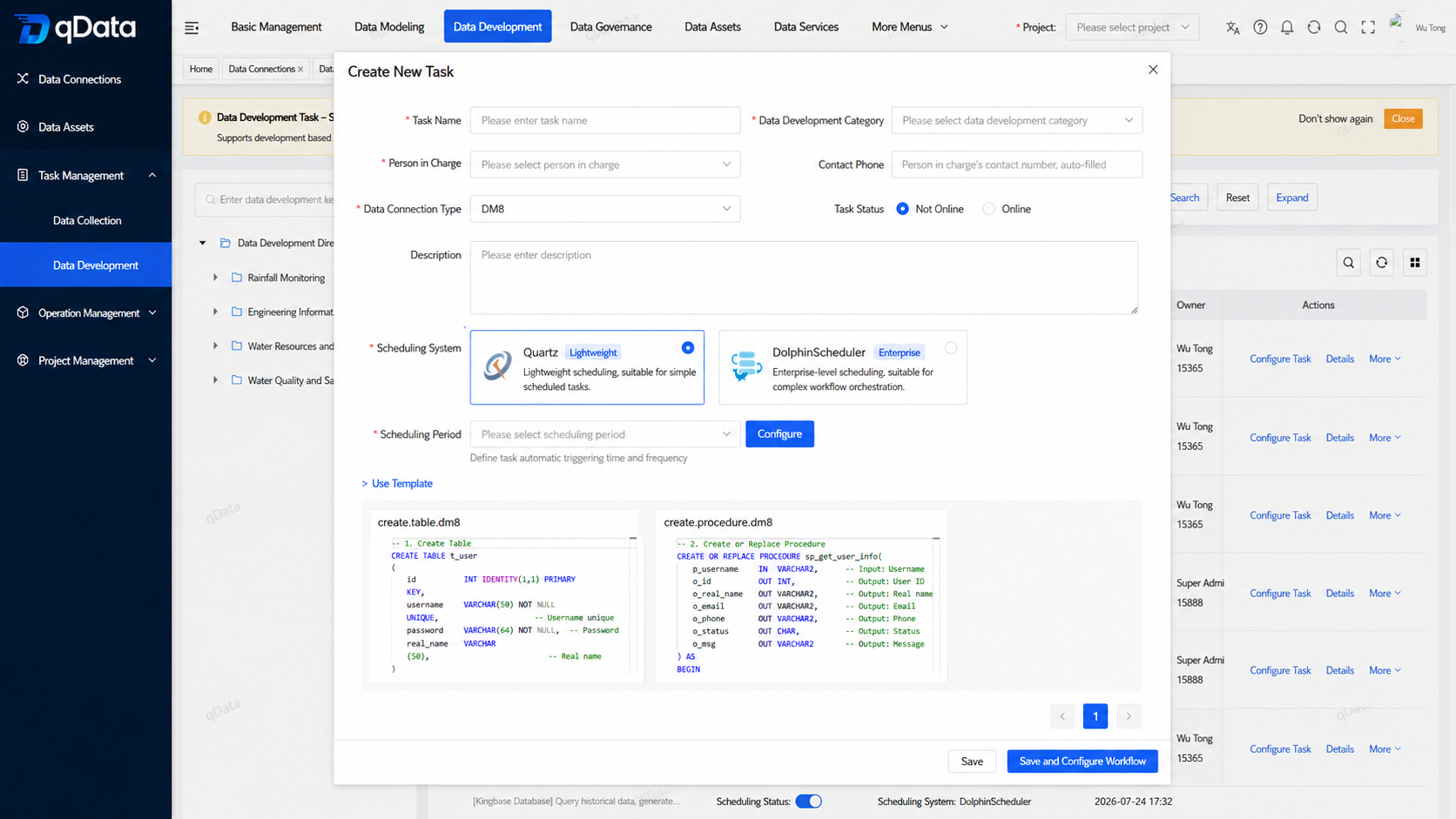 |
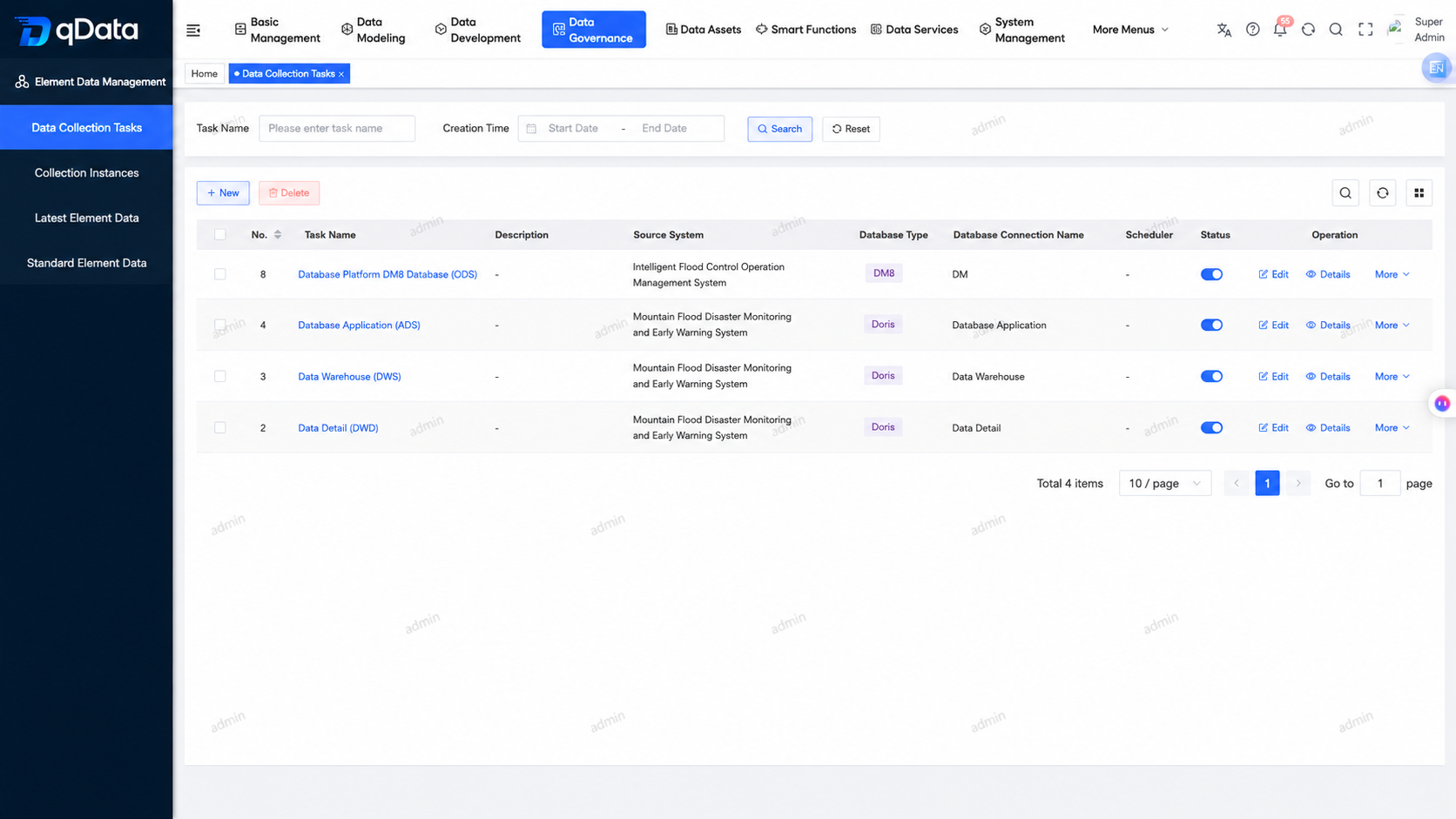 | 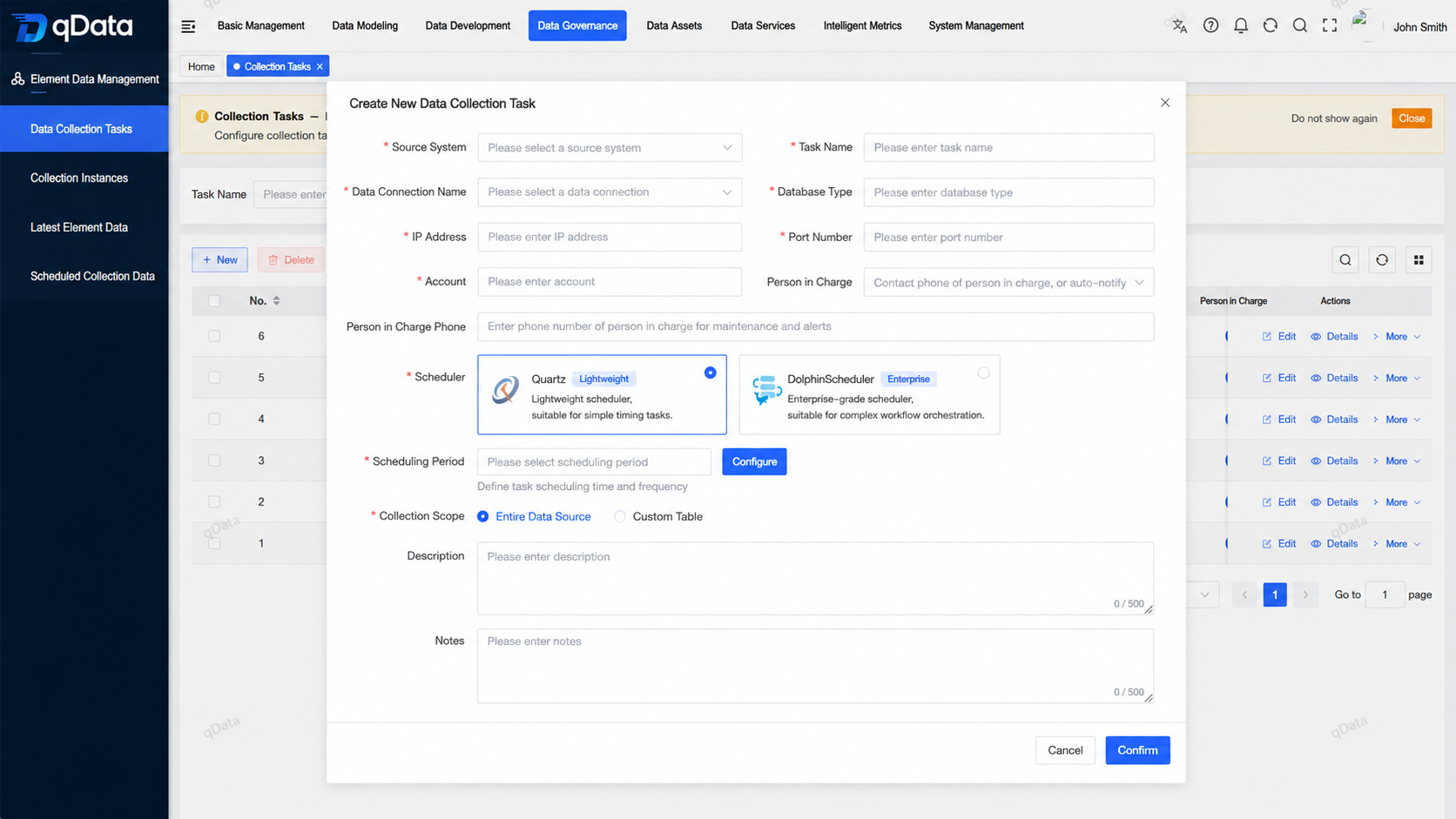 |
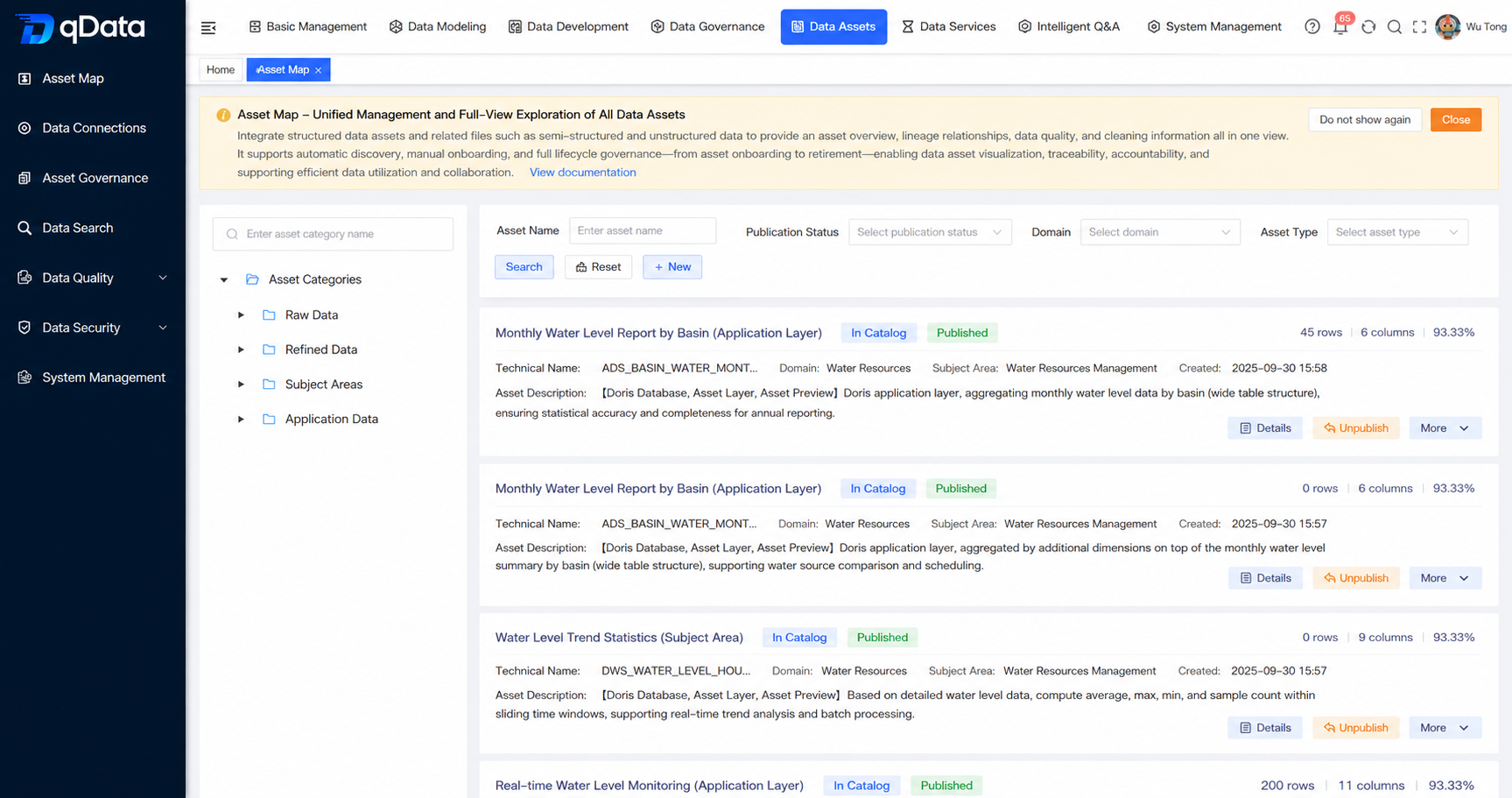 | 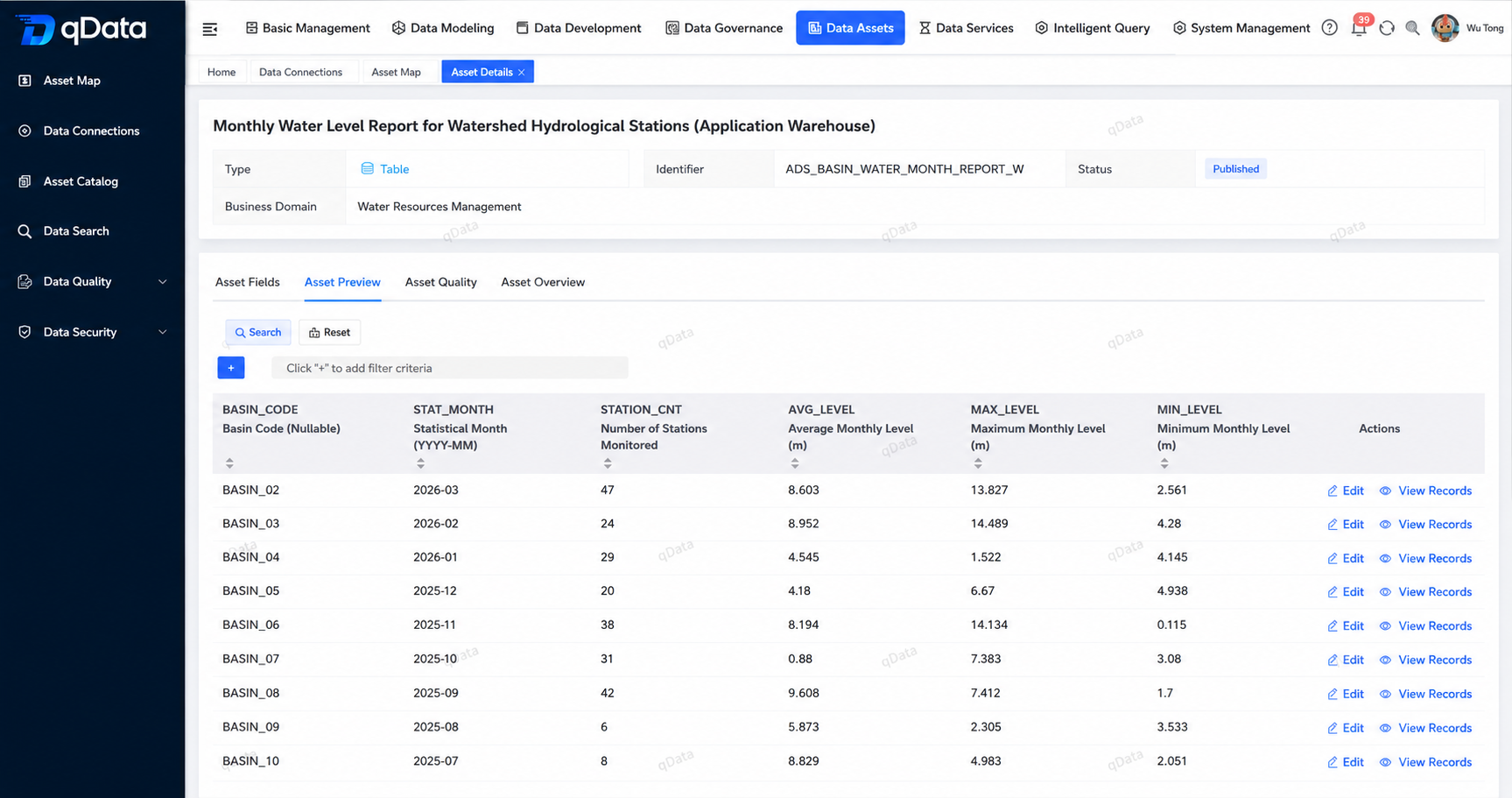 |
 |  |
 |  |
 |  |