
Performance Bottleneck Analysis and Tuning Strategy
1. Data Platform and Big Data Platform
1. What is a data platform?
A data platform is a technical platform that helps enterprises build unified data assets, break down data silos, and serve business systems. It provides the following core capabilities:
- Connects to multiple types of data sources, including structured, semi-structured, and unstructured data;
- Provides unified data governance, standard modeling, permission management, development, and operations capabilities;
- Exposes unified data services to frontend business systems, supporting reports, analytics, APIs, and other formats;
- Builds an enterprise-level "data resource pool" that provides foundational support for multiple business units.
In short, a data platform is an "integration and enablement platform for data capabilities".
2. What is a big data platform?
A big data platform is distributed computing and storage infrastructure designed to process massive data volumes. It usually includes the following core components:
- Computing engines: such as Spark and Hive, used for batch processing and interactive queries;
- Storage systems: such as HDFS, HBase, and Hive tables, used for file storage, KV storage, and structured storage respectively;
- Resource management and scheduling tools: such as Yarn, Kubernetes, and DolphinScheduler;
- Monitoring and alerting systems: used to ensure secure and stable platform operation.
The core of a big data platform is "data computing capability that supports high throughput, scalability, and elastic processing".
3. Interaction between the data platform and big data platform
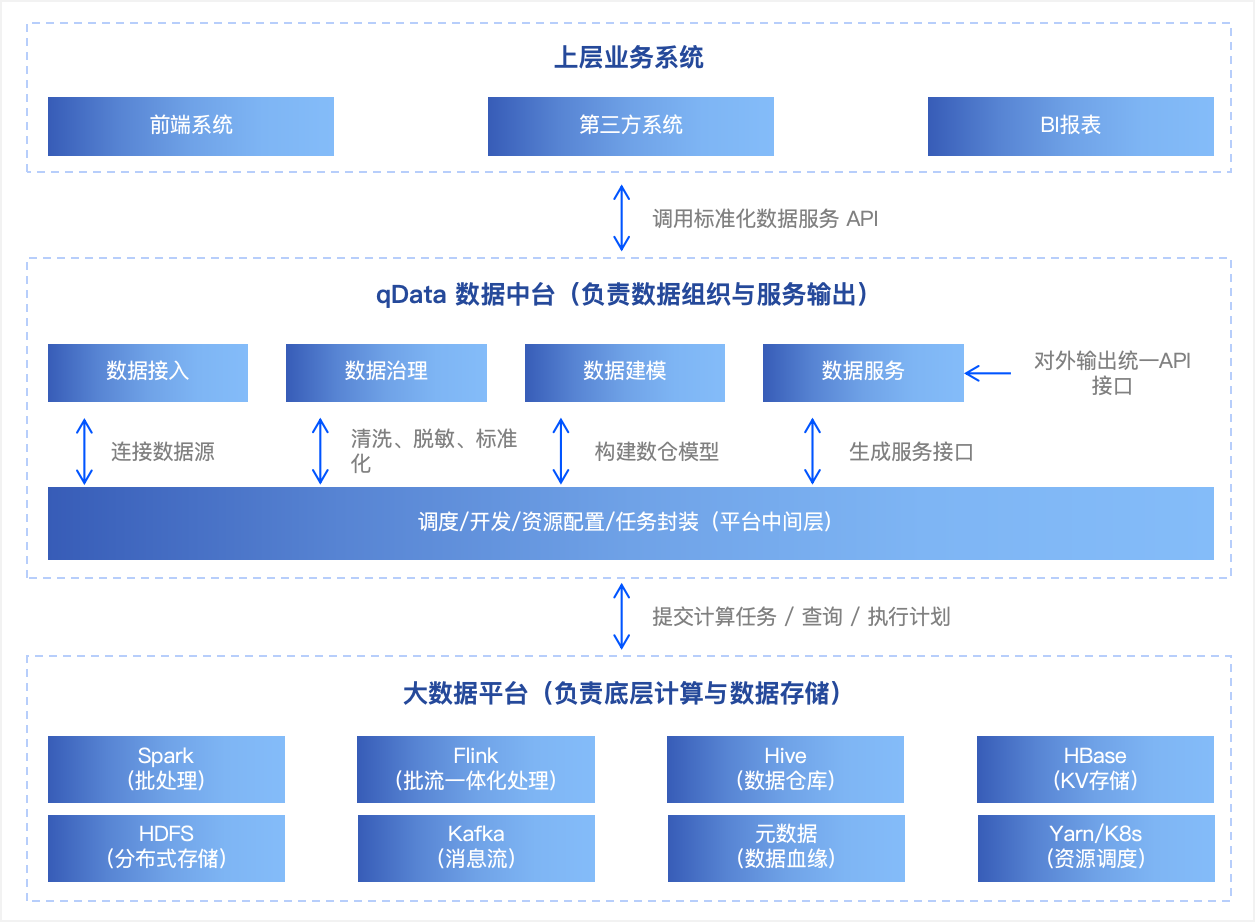
| Layer | System/Platform | Responsibility Description |
|---|---|---|
| Upper layer | Upper-level business systems | Call APIs provided by the data platform to obtain result data, without directly accessing the underlying data platform |
| Middle layer | qData Data Platform | Organizes data sources, modeling governance, API encapsulation, and task scheduling management, acting as the "data service provider" |
| Bottom layer | Big data platform (Spark, Hive, etc.) | Handles actual data processing and computing tasks, acting as the "data processing executor" and "performance core" |
🔍 Key Points
- Data platform connects to upper-layer systems: it encapsulates APIs uniformly and reduces the complexity of business systems accessing data;
- Data platform schedules lower-layer platforms: it reasonably schedules Spark and other engines based on tasks and configuration developed by users;
- Performance tuning mainly focuses on the bottom layer: resource configuration, data model design, and computing logic optimization mainly depend on big data platform tuning;
- The data platform supports configurable calls and a unified entry point: it acts as a bridge and control center, but does not bear the core computing pressure.
2. Where the Data Platform May Affect Task Performance and How to Respond
qData itself does not directly participate in underlying big data computation, but it can affect performance in task configuration, API calls, and related areas. The main factors are summarized below:
| Module/Stage | Potential Performance Impact | Underlying Reason | qData Response Capability |
|---|---|---|---|
| Task resource parameter configuration | Data development tasks run for a long time, occupy resources, or fail | Spark and similar tasks need reasonable CPU and memory resources; undersized configuration reduces efficiency | qData provides resource parameter configuration entry points and supports differentiated configuration templates for different task types |
| Third-party tool API encapsulation | Poor data processing efficiency and slow queries | Third-party engine APIs vary greatly, and inefficient usage can significantly reduce performance | qData encapsulates task invocation methods and provides recommended usage, best practices, and documentation guidance |
| Slow data service API response | Slow page loading and high API pressure | Hot APIs query large tables every time, without caching, increasing system pressure sharply | qData supports cache rules, API rate limiting, load balancing, and other strategies |
| System deployment architecture selection | Single-node performance bottlenecks and difficulty scaling | Monolithic deployments can hit concurrency bottlenecks and struggle to support heavy traffic | qData supports microservice deployment, flexible service module splitting, and horizontal scaling |
3. Performance Bottleneck Design for Big Data Projects
1. Where are the main performance bottlenecks in big data platforms, and how should they be handled?
qData is the scheduler and organizer. The underlying big data platform is what actually handles large-scale computing tasks. Common performance bottlenecks in these platforms include:
| Possible Bottleneck | Common Symptoms | Cause | Recommended Optimization | Responsible Party |
|---|---|---|---|---|
| Insufficient resource configuration | Spark tasks fail or run slowly | Default parameters do not distinguish task types, and resources are insufficient for large tasks | Set executor CPU/memory reasonably and assign templates by task level | Implementation team or platform administrator |
| Severe data skew | Abnormal load on certain nodes and slow tasks | Too much data is concentrated on specific keys, causing uneven node load | Add random factors (salting), scatter hot values, and pre-aggregate | Implementation data engineer |
| Unreasonable table structure design | Full table scans and very slow joins | Tables are not partitioned, indexes are missing, or inefficient storage formats are used | Use Hive partitioned tables plus columnar storage such as Parquet, and create indexes | Data warehouse modeler |
| Complex scheduling dependencies | Long overall scheduling chains and easy failures | Tasks are split too finely and dependencies are cumbersome | Merge tasks reasonably and optimize the DAG chain structure | Implementation scheduler |
| Large-table API queries without caching | Page freezes and API failures | Hot APIs query raw detail tables every time, causing large computation volume | Use cached intermediate tables or API caching mechanisms | Implementation team or data platform configuration staff |
2. Recommended Project Role Responsibility Division
To ensure overall system performance, clarify responsibilities across roles and optimize collaboratively:
| Key Project Stage | Main Work | Responsible Party | Reason |
|---|---|---|---|
| Big data platform deployment and configuration | Install Spark, Hive, and related components and configure resource scheduling mechanisms | Customer or implementation team | Resources are provided by the customer or maintained by a partner |
| Resource scheduling and task tuning | Set resource parameters for each task type | Implementation team | The implementation team understands business scenarios and task characteristics, so it should set resources reasonably |
| Data warehouse modeling and table structure design | Table creation, partition strategy, and storage format design | Implementation team + business side | Models must consider both business and computing efficiency, requiring collaboration from both sides |
| Data API design and publishing | Export APIs and configure cache rules | Implementation team + qData users | qData provides tools and platform capabilities, while the usage team defines invocation logic |
| qData platform deployment and parameter configuration | System architecture design, module deployment, and configuration optimization | Us (qData product provider) | Platform product capabilities and parameter configuration require complete support from us |
| Database read/write optimization (such as MySQL) | Deploy primary-secondary architecture and read/write splitting | Customer | The customer owns database permissions and infrastructure resources |
4. Summary
- qData itself does not directly execute big data computation. Its system architecture is stable and performs well;
- The real performance core lies in big data platform resource configuration, data structure design, and invocation methods;
- qData already provides rich performance parameter configuration capabilities, including task resource configuration, API cache strategies, and microservice deployment;
- We recommend that customers have the implementation team plan the underlying data architecture uniformly at the beginning of the project, and combine it with our platform capabilities to form an overall controllable performance solution;
- We can also provide paid technical support and consulting services for performance optimization based on customer needs, helping identify system bottlenecks and provide professional optimization recommendations, ensuring qData stably supports business data needs in complex scenarios such as water conservancy, manufacturing, and government affairs.